

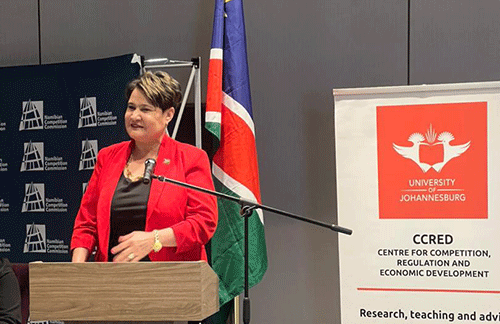

The creation of a competition compliance culture within Namibia’s various economic sectors is of utmost importance. This is because compliance with competition regulations not only creates a level playing field for businesses but ensures all businesses are held to the same standards, regardless of their location, and helps prevent unfair competition practices.
This was part of the message shared by deputy minister of industries, mines and energy, Gaudentia Kröhne, when speaking last week Thursday at the tenth Annual Competition and Economic Regulation (ACER) Week that was hosted in Windhoek. The two-day event was co-hosted by the Namibian Competition Commission, in collaboration with the University of Johannesburg’s Centre for Competition, Regulation and Economic Development (CCRED).
“I am particularly pleased that these training programmes are not mere tokens of attendance but are certified by University of Johannesburg to endorse the empowerment of professionals in the fields of competition law and competition economics. As the Government of the Republic of Namibia, we do not take these types of exercises lightly as we are on the road to creating a self-reliant society and industrial nation,” said Kröhne.
She added that the inclusion of discussions on developments in regulatory frameworks for digital platforms, which also address the implications of changing technologies such as renewable energy for economic regulation to support sustainable industrialisation, are important factors in assessing and strengthening the regulatory mandate of the competition commission.
Said Kröhne: “This ties in with one of the main priority areas as the ministry is in the process of introducing policy frameworks that will strengthen regulations and addressed legal loopholes in government’s strides towards transformative actions aimed at achieving its vision of an industrial nation. By implementing policies that align with national development goals, government aims to foster the growth of industries and the upliftment of the social conditions of our people”.
She elaborated that one such policy is the recently launched National Development Plan 6, whose objectives are to promote sustainable economic growth and address the challenges of poverty, unemployment and inequalities.
The Annual Competition and Economic Regulation Week is a rotational event, which commenced in March 2015 with the Zimbabwean Competition and Tariff Commission (CTC) being the first co-host with the CCRED.
Moreover, Kröhne pointed out that the other area of the competition training centred around competition economics, incorporating advancements made in the regulation of energy and telecommunications markets.
“Bringing together stakeholders from developed and developing countries, including competition authorities, sector regulators, businesses, and interested parties, is key to advancing competition law and policy world-wide. These types of collaborations enhance evidence-based approaches and active engagement by competition authorities to promote competitive markets and address global challenges effectively”, said Kröhne.
In 2020, government launched the “National Competition Policy, 2020-2025”, with the aim to foster economic development by encouraging competition and innovation in markets; seek to prevent anti-competitive practices and ensure a level playing field for businesses; address regulatory barriers that hinder competition and economic efficiency; support Micro, Small and Medium-sized Enterprises by creating an enabling environment; and consider public welfare and consumer interests while promoting competition.
“Well-designed and effectively implemented competition laws can foster innovation, enhance efficiency, and promote fair market practices, ultimately contributing to economic, social, and environmental progress. By prioritising key sectors, addressing anti-competitive practices, and ensuring fair competition, competition law can serve as a powerful tool to create equitable opportunities and improve the welfare of all, particularly the most vulnerable,” Kröhne added.
“I would like to emphasise that ongoing collaborations between sector regulators, industry representatives and policymakers such as these, are necessary to ensure that regulation is effective, efficient, and supportive of economic growth…It is my sincere wish that today and tomorrow’s deliberations will culminate into lessons that will steer Southern Africa’s competition authorities in driving legal frameworks inclusive of addressing possible challenges that come with technological advancements such as artificial intelligence, as well as interrogate how competition authorities can navigate competition challenges that may arise from the oil, renewable energy and green hydrogen sectors,” said Kröhne.