

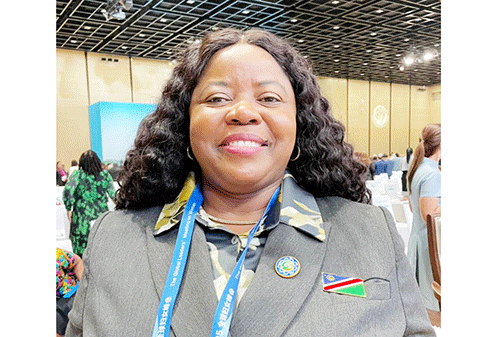

BEIJING – With the election of the country’s first female president and National Assembly speaker, Namibia is a shining example of women’s empowerment, leading the chart in Africa and eighth globally, Deputy Minister of International Relations and Trade, Jennely Matundu has said.
Matundu made these remarks in Beijing, China, recently during the Global Leaders’ Meeting on women.
While acknowledging that more work lies ahead in achieving total gender equality, Matundu was quick to note that Namibia has made significant progress, worthy of recognition and emulation.
“Namibia has a story to tell. We know where we are coming from, the days of our armed liberation struggle, and how we have really advanced to make sure we bring our women to the decision-making table. As we speak, to quickly touch on the 8th administration, Namibia has produced its first female President, (Netumbo Nandi-Ndaitwah) in the history of Namibia. It didn’t come on a silver platter,” Matundu said.
In 2000, Namibia adopted Resolution 1325 in line with the Beijing Platform of Action, “where we made sure to bring our women on board,” she noted.
While progress has been made, challenges do persist, Matundu, a former employee of the gender ministry, hastened to say.
“Challenges are still there. One recognises that our rural women, when it comes to issues of access to land, finance, and more. But I am happy that the sixth national development plan and other national frameworks are really working hard to address those issues affecting women by supporting their micro-businesses. We are not 100% there. But we have a female president and a female vice president (Lucia Witbooi), and we have the first female speaker; 57% of the Cabinet ministers are women, and the Namibian parliament accounts for 38.5% women’s representation. What more can we ask for?” she rhetorically asked.
She then appealed to opposition parties to adopt the 50/50 gender representation to achieve gender parity.
“We must make sure our parliament is 50/50 or more. From the ruling party (Swapo), it’s already 50/50. The problem is with the opposition party. They need to work more and adopt the gender equality protocol so that they can also start supplying on a 50/50 basis, similar to the zebra style. You cannot have a party in parliament that is just represented by men. Are they the only good thinkers, or what are we trying to say? We are working hard and praying for them to realise and bring up women who are in their political parties to come on board,” she said.
On some of the key positions, Namibia will advance during the meeting, she said, “Namibia is not separated from other African countries. From this workshop, we are making a genuine effort… the challenges persist. Our rural women are not yet at the decision-making table. However, as a country, we have established the Rural Women’s Parliament. We are trying to ensure they bring their own issues to the fore. We are here to take best practices from others and also share what we have achieved.”
Global situation
According to a report on the role of parliament in implementing the Convention on the Elimination of All Forms of Discrimination Against Women (CEDAW), only six countries have achieved gender parity.
“If one looks at women parliamentarians and women in politics, which, by the way, is one of the spotlights, only 26.5% of women are in parliament. In 36 countries, we have a woman as the head of state or government. There is progress, but it would take 150 years to realise equal participation in politics and meaningful participation fully,” UN High Commissioner for Human Rights Volker Türk said in the report.
The report furthermore sheds light on a myriad of challenges faced by female MPs and women in politics in general.
“Gender-based violence (GBV) at home and in the public sphere, and even in political life, is a global phenomenon that constitutes a key barrier to women’s political participation. GBV in politics targets women more than men, e.g., sexist threats, sexual harassment, and online harassment, and female political candidates and journalists are exposed to online GBV,” the report said.
There are also deeper-rooted gender stereotypes defining the roles of men and women, often associated with women being excluded from rooms where strategic decisions are made.
Sexual harassment is another worrisome harbinger, keeping women at the periphery of global politics.According to statistics, one in three women worldwide faces sexual harassment in their lifetime, a worrisome concern, especially when it comes to women in the political arena.