


The Namibia Employers Federation (NEF) has welcomed a renewed global focus on the three fundamental pillars of social development: poverty eradication, full and productive employment and decent work for all, and social integration.
The NEF emphasised that these pillars align closely with Namibia’s national development goals. The federation emphasises that the three pillars are essential foundations for a fair and resilient society.
The federation also advances the belief that achieving the three pillars of social development depends on a strong and competitive private sector which is supported by transparent, predictable, and inclusive processes.
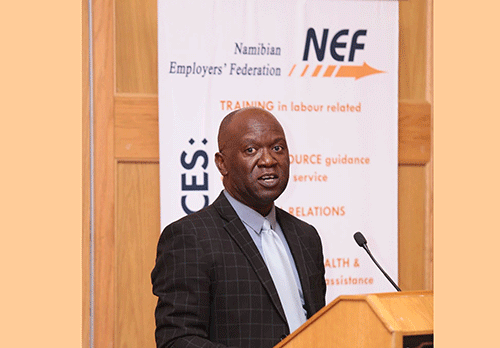
President of the NEF, Elias Shikongo, commented that “We all want a Namibia where people have work, skills, and opportunity, and to achieve that, we must work together and create conditions that allow businesses, especially small and medium-sized ones, to grow sustainably. When enterprises thrive, they generate employment, build skills, and contribute directly to national development.”
“Employers recognise that eradicating poverty, creating sustainable employment, and strengthening social cohesion require a national effort, one that depends on close cooperation between government, labour, and business,” the NEF stated.
The NEF’s support for these pillars comes in the wake of the Second World Summit for Social Development, which took place this week in Doha, Qatar. Expressing full support for the summit’s ambitions, as reflected in the Doha Political Declaration, the NEF reiterated that lasting progress must rest on practical and transparent policymaking.
The NEF further emphasised that effective social dialogue is founded on trust, and that trust is fostered when policy reform processes are transparent and well-communicated.
“Employers, therefore, call for clear timelines and consistent consultation frameworks when developing and implementing labour policies and legislation. Transparent milestones and adequate consultation periods allow all stakeholders to prepare effectively, contribute meaningfully, and align their efforts toward shared outcomes,” the federation stated.
The NEF also emphasised that a thriving business environment is crucial for sustainable development. Businesses, including small and medium-sized enterprises (SMEs), which form the backbone of Namibia’s economy, require access to finance, reduced administrative burdens, and policies that enable them to grow, innovate, and create employment opportunities.
Moreover, the federation reaffirmed its commitment to the principles of tripartism and meaningful social dialogue, noting that collaboration among employers, labour, and government remains the foundation of Namibia’s economic and social stability.
“The NEF calls for continued partnership to translate the global commitments of the World Summit into tangible actions, reducing poverty, expanding decent work, and strengthening social inclusion for all Namibians, in business-friendly environment where all
can thrive,” the NEF stated.
-ebrandt@nepc.com.na