

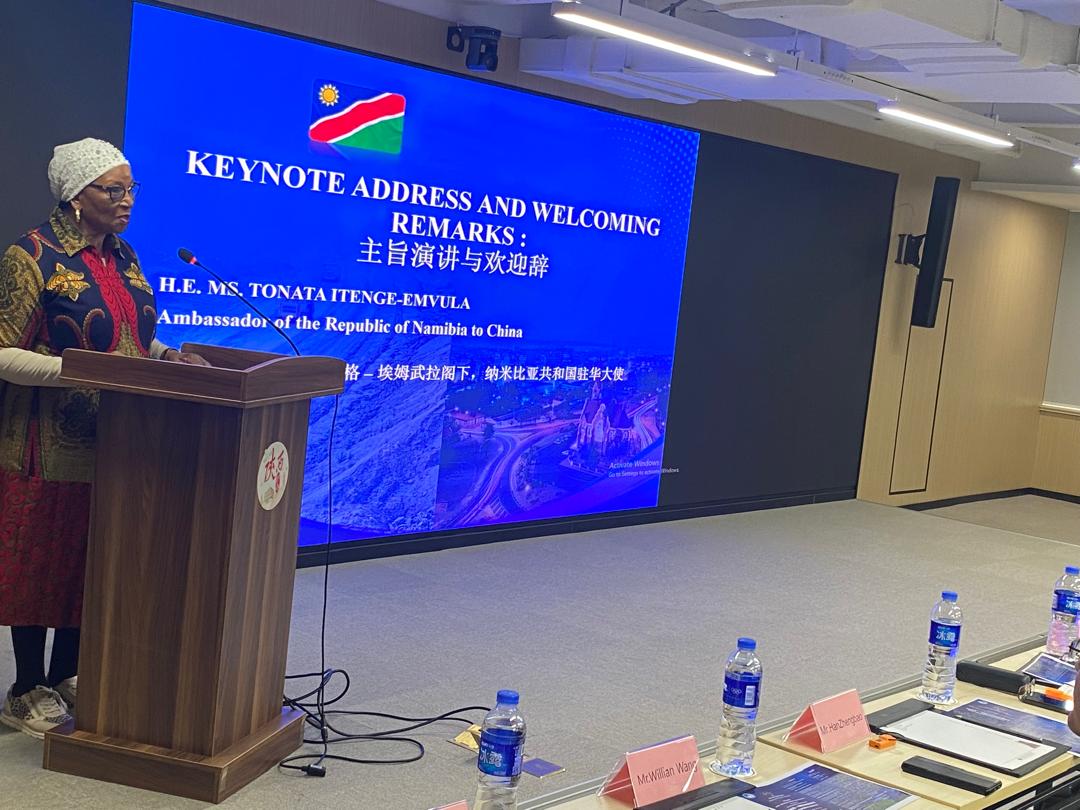
BEIJING – Namibia’s new Ambassador to China, Tonata Itenge-Emvula, recently made her maiden address on the global stage, asserting the country’s position as an ideal investment destination. Itenge-Emvula particularly pointed to Namibia’s growing potential in the oil and gas, agriculture and food industries as key investment sectors.
“Agriculture is also key to our development; food security would reduce poverty as well as reduce the import of agricultural goods into Namibia. Manufacturing of automotive components, especially the introduction of electrical vehicles and their value chain into Namibia and export to the rest of Africa. Last but not least, to ensure that Namibia is energy sufficient and can export access to the region and world. Any investment has to take into consideration that Namibia has to benefit from its resources; then we are on the same level of thinking,” she remarked.
She was speaking on the sidelines of the recently concluded China International Import Expo (CIIE) in Shanghai, China’s investment and business capital. The Namibia-China trade and investment opportunities forum was attended by officials, diplomats and investors.
“Now, allow me to speak a little bit specifically of Namibia, the Land of the Brave. Potential opportunities in trade and investments in the priority sectors of oil and gas, metal and mineral mining and processing, renewable energy, agriculture and food industry, manufacturing and logistics are key development highlights the country is embarking upon,” Itenge-Emvula said.
“The development of a large-scale green hydrogen project on the southern coast of Namibia. Namibia has captured the attention of the global energy community through the oil and gas discoveries with estimated volumes of over 3 billion barrels,” she said.
Itenge-Emvula further stated that, “As we speak Namibia is the third largest producer of uranium in the world, and we have Chinese companies that have invested in this sector, such as CNNC and CGNPC uranium resources.”
Additionally, Namibia has biomass potential and abundant wind and solar resources for energy project development for local distribution and export to the regional power pool, the diplomat continued.
“We are the only African country currently that can export beef to China, the European Union, and the United States of America. Beyond energy and agriculture, Namibia’s breathtaking landscapes, diverse culture, and rich wildlife make it an irresistible tourism destination. Namibia has a thriving, growing, and exciting mining industry,” she noted.
Moving to the continent, she reminded the guests about Africa’s Agenda 2063, which was launched in 2015. This is the blueprint and masterplan for transforming Africa into a global economic engine.
“We are seeking partnership from China that will transform our continent to achieve its vision 2063. Namibia is a beneficiary country of the Forum on China Africa Cooperation (FOCAC) programs and a party to the Belt and Road Initiative. Thus, Namibian and Chinese enterprises can enjoy support by both governments in their business endeavours,” she noted.
She said that, “Having said so, such instruments create a vehicle for enterprises like those present here to engage and identify opportunities that align with our national developmental goals that align with FOCAC’s nine areas of support.”
She said Namibia is “here to seek investors that can partner with us to add value to our resources, such as copper, uranium, lithium, nickel, and cobalt, among others, and create jobs and wealth for the Namibian people and Chinese investors.”
Itenge-Emvula then told investors and interested parties that the Namibian embassy in Beijing is open to facilitate required visas for those that want to travel for business or tourism.
“We are ready to cooperate for win-win benefits. I look forward to meeting serious investors in Beijing as we further our discussion,” she said.
The CIIE was held earlier this month. It was hosted on 430 000 square metres at the National Exhibition and Convention Center in Shanghai, and 449 500 professional visitors have registered.
As expected, innovation was at the heart of this year’s expo, with over 460 new products, technologies and services, including low-altitude economy and humanoid robots.
Roughly 23 000 overseas exhibitors have participated in the past seven editions, showcasing around 3 000 new products, services and technologies.
The expo saw 4 108 exhibitors from 155 countries, regions and international organisations participate in national and corporate exhibitions.
The expo further seeks to reaffirm China’s commitment to opening its markets while promoting trade and investment.
Through the CIIE platform, more than US$500 billion worth of deals and investment have been delivered. Since 2018, the CIIE has promoted international procurement, investment, people-to-people exchanges and cooperation.