

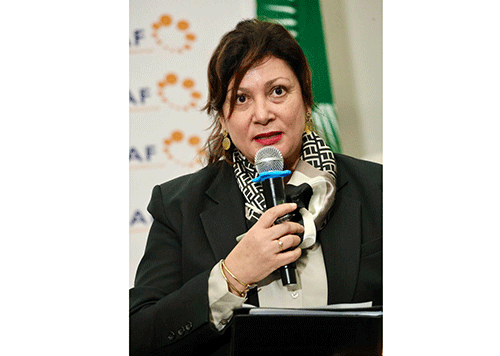

Rudolf Gaiseb
The Namibia Students Financial Assistance Fund (NSFAF) vows to ensure stringent compliance with the eligibility criteria of the new funding model.
The institution states it will guarantee the subsidy reaches its intended beneficiaries.
In 2025, prior to the subsidy, NSFAF awarded 30 138 deserving Namibian students with financial assistance amounting to N$3.1 billion for both tuition and non-tuition fees.
This was out of 41 322 applications.
Now, NSFAF anticipates a spike in applications because of the subsidised tertiary education funding model.
The parental income threshold was also lowered and stands at N$300 000; this too, is envisaged to contribute to the increase.
“We will be the custodians of data, meticulously maintaining records of all students supported under this new model, ensuring accountability and informed policymaking,” acting chief executive officer Kennedy Kandume said at the launch of the NSFAF 2026 online application yesterday.
He also said the application system is the critical gateway through which students will access transformative support: “It represents our commitment to efficiency, transparency, and user-friendly service.”
Nevertheless, NSFAF will still award non-tuition loans through a vigorous means-testing process, beyond the tuition subsidy, ensuring comprehensive support for students’ living and learning needs.
But NSFAF remains adamant that the recovery of any student loan due to the fund will continue until further notice.
This is to maintain the sustainability of the fund for “future generations.”
Meanwhile, a national list of priority fields of study is currently under construction in consultation with relevant stakeholders to align the national investment with developmental goals.
Meanwhile, Minister of Education, Innovation, Youth, Sports, Arts, and Culture Sanet Steenkamp invited private partners to support the government’s “equity-driven” financing mechanisms to assist students with the biggest educational needs.
To strengthen quality, coherence, and confidence in the education system, the government continues its phased implementation of national minimum standards across tertiary institutions.
Steenkamp wants the private sector to support these efforts by investing in innovative delivery models and quality digital learning, as well as expanding access through flexible pathways and safeguarding academic standards.
It was highlighted that the cost of living while studying remains a real and pressing challenge for many students, especially those from disadvantaged backgrounds.
Therefore, the government provides non-tuition support (N$17 000) through the subsidised tertiary education funding model.
“While the amounts provided may not always meet every need in full, they offer a critical lifeline, enabling students to remain enrolled, focused, and committed to completing their studies,” she said.
Overall, the funding model is viewed as “needs-based” and “developmental,” and it is more than disbursing financial assistance.
“We invest in human potential. We are nurturing skilled professionals, innovators, and responsible citizens who will have to contribute in time, meaningfully, to Namibia’s social and economic advancement,” Steenkamp said.