

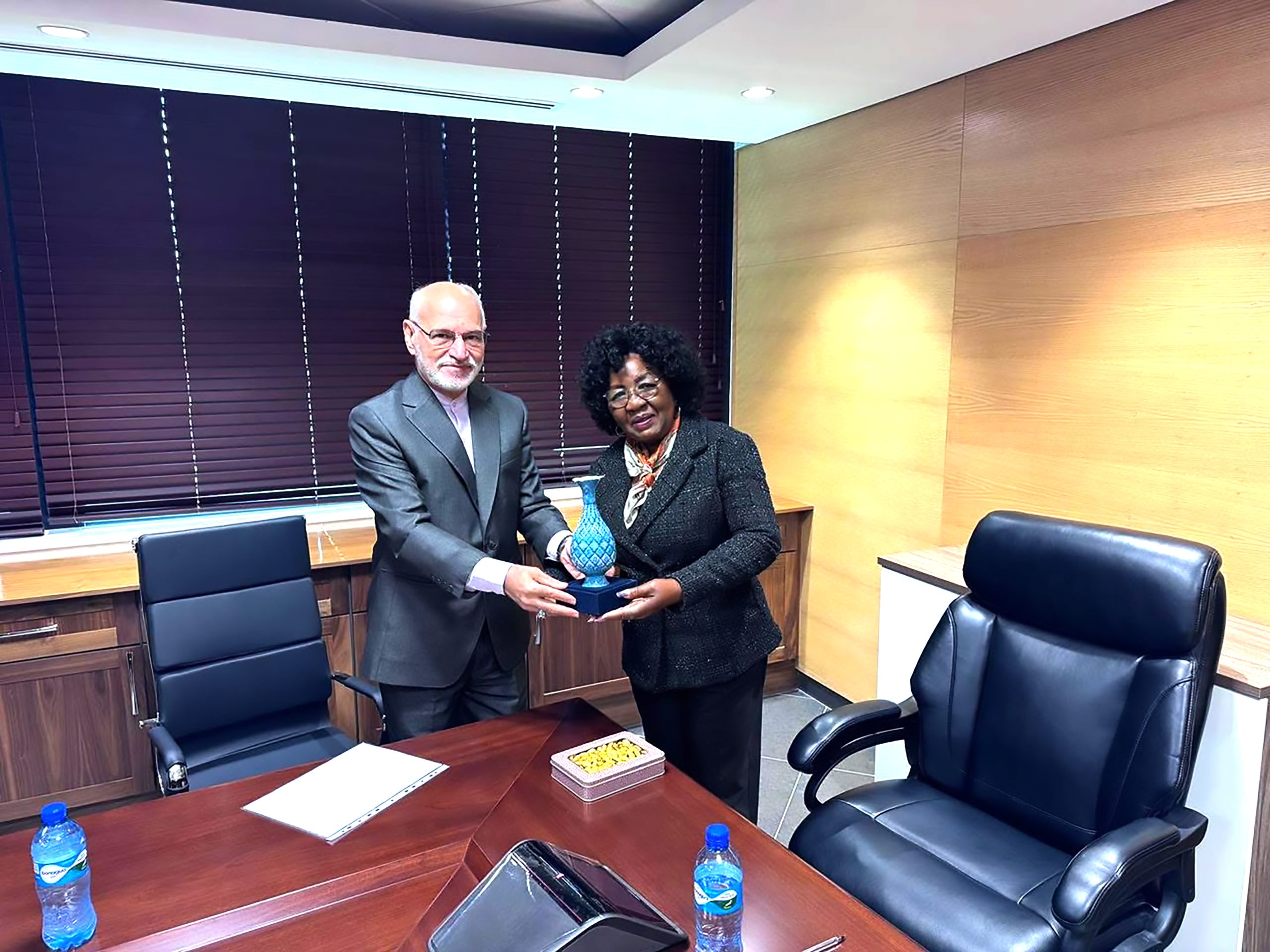

Swapo secretary general Sophia Shaningwa yesterday condemned the US-backed Israeli military operation against Iran, which resulted in the killing of the latter’s supreme leader, Ali Khamenei.
Taking to her official social media platforms, Shaningwa confirmed meeting Mohammad Baqer Beigi, Iran’s ambassador to Namibia.
“In the wake of Israel’s and the USA’s unjustified aggression and illegal military operation against Iran and its people, resulting in the senseless killing of Ayatollah Ali Hosseini Khamenei, we offer our sincere condolences to the people of Iran and stand in solidarity with them, just as they stood with the people of Namibia during the course of the national liberation struggle waged by the Swapo Party,” she said.
She emphasised Swapo attaches great value to the historical support extended to Namibia during its struggle for independence and reiterated the party’s commitment to long-standing international alliances rooted in anti-colonial solidarity.
“We reject imperialism and advocate for peace, multilateralism, togetherness and global peace amongst nations,” she said.
Namibia
Meanwhile, the Namibian government earlier condemned the US-Israeli military strikes, describing them as a serious escalation with far-reaching global consequences.
In a media statement issued on Monday, the Ministry of International Relations and Trade said it notes “with grave concern” the recent escalation of tension in and around the Middle East.
“Such developments heighten tensions in an already-fragile region and risk further destabilising international peace and security,” the ministry said.
Namibia stressed its commitment to international law and the principles of sovereignty.
“The government of the Republic of Namibia reiterates its firm commitment to the principles of sovereignty, territorial integrity and non-interference in the internal affairs of states as enshrined in the Charter of the United Nations and international law,” the statement reads.
Analysis
To gauge the veracity of the escalating situation and possible implications at home, New Era solicited views from some local commentators.
Lawyer and analyst Natjirikasorua Tjirera said the impact of the conflict is already being felt in Namibia.
“Recently, we learned that the price of fuel will increase. This is a direct consequence of the highly irresponsible actions by Trump and his administration,” Tjirera said.
He added that fuel is central to global economies and that instability in the Middle East, a key oil-producing region, will disrupt the global economy.
“Fuel runs economies across the globe, and the Middle East is the biggest primary source of oil in the world. Thus, a disruption of order in that region will have consequences of disrupting the global economy. As citizens of the world, Namibia is bound to suffer as well,” he said.
Tjirera criticised the international community and the United Nations for what he described as a failure to act decisively.
“It gives people like Donald Trump the arrogance to believe that the entire world is his playground as he continues to violate international law with impunity,” he said.
He warned that the situation could worsen if world leaders do not act.
“The sovereignty of nations is compromised – and unless the world leaders stand up for once and tell the Americans where and when to get off their high horse, the situation will only become worse,” he said.
Like Tjirera, political analyst Ndumbah Kamwanyah said the impact is not limited to the Middle East.
“From a global perspective, a military confrontation involving the United States and Israel against Iran carries significant economic implications, particularly for energy-dependent regions such as Africa,” he stated.
He added, “Any disruption in or around strategic maritime chokepoints such as the Strait of Hormuz could constrain global oil supply, leading to higher fuel and transport costs.”
He said broader trade routes connecting African economies to Asian and European markets could also be affected.
On international law, Kamwanyah noted: “Under the United Nations Charter, the use of force is generally prohibited, except in cases of self-defence or when authorised by the United Nations Security Council.
“If military action is perceived as pre-emptive or lacking clear multilateral authorisation, it may weaken established norms governing state sovereignty and non-intervention.”
He warned that such precedents could normalise unilateral military action and weaken global governance systems.
“For smaller states, including those in Africa, the erosion of these norms is particularly concerning because international law and multilateral institutions serve as key safeguards against coercion by more powerful states,” Kamwanyah said.
He then cautioned about the risk of wider conflict.
“The Middle East is already characterised by overlapping conflicts and proxy dynamics involving major powers. A confrontation with Iran could draw in regional actors and non-state armed groups, destabilising neighbouring countries and threatening critical infrastructure,” he said.
Kamwanyah noted that global power competition could intensify if countries such as Russia or China take stronger positions in response.
“This could further polarise the international system, weaken cooperative mechanisms and complicate global efforts on issues such as nuclear non-proliferation, maritime security and counterterrorism,” he said.