


University education is free and compulsory in some quarters, while expensive in others that ordinary citizens cannot afford it.
University education evolved and developed, becoming an economic pillar of any developing country. The word university comes from the Latin word universitas which means a corporation of teachers and students.
Many universities administrators carry titles such as chancellor, provost and dean, which were used to designate the officials of cathedral chapters during the Middle Ages.
During those early years, lecturers were fined if they missed a class, began their lectures late, or failed to complete their scheduled programme for the term. In northern Europe the University of Paris became the first recognized institution of higher learning at university level.
The curriculum centred on the traditional liberal arts such as grammar, rhetoric and logic, done through the lecture method. It is important to note that the word, ‘lecture’ is derived from Latin and means ‘to read,’ because before the printing press, books were very expensive and many students could not afford them, hence masters read from texts.
The early universities in Africa included Al Azher University in Egypt, the University of Fez in Morocco and the University of Timbkutu in Mali (Amukugo 1993; Rodney 1973). Around the 12th Century (A.D.), the University of Timbuktu in Mali flourished with 25 000 students from all corners of the African continent and beyond, in search of excellence in knowledge, wisdom and moral conduct.
The University curriculum had four degrees or levels. The primary level emphasized the mastery of the Arabic language, effective communication and writing skills. In addition, students were further introduced to other sciences.
The secondary level was where students learnt grammar, jurisprudence, physics, astronomy, chemistry and ethics. The third stage was the superior level, where students were exposed to research work under a professor.
Finally, the fourth and last stage was the circle of knowledge level, where scholars and students would discuss crucial issues.
On graduation day, students were given turbans which symbolized divine light, wisdom, knowledge and excellent moral conduct. Turbans further represented the demarcation line between knowledge and ignorance. The University of Timbuktu produced scholars of high reputation and knowledge, like Ahmed Baba Es Sudane of Timbuktu, who devoted his time to learning until he surpassed all his peers and contemporaries. His academic reputation spread all over Sub-Saharan Africa and North Africa.
He had a library of 1 600 manuscripts and authored sixty books on theology, grammar, history and Jurisprudence; more than what Shakespeare had written. These manuscripts are a living testimony of the highly advanced and refined civilization in Sub-Sahara Africa, as Timbuktu flourished as the greatest academic institution before the European Renaissance.
During colonialism, Africans were denied the opportunity of establishing institutions of higher learning, as a way of retarding the educational development and emancipation of the indigenous people (Snelson, 1974).
But after independence Africa saw and witnessed the mushrooming of universities and these institutions of higher learning became centres of prestige and havens of resistance, as students started challenging the oppressive regimes of many African leaders. The universities have become think tanks of nations. There are sources of new information and theories in various fields, including medicine, that some of the universities are attached to big hospitals.
Some of the great thinkers of all ages had come from universities (Rusk and Scotland, 1985). As young generations, enter universities, this should be put into good use by studying, in order to create and add on the already existing knowledge for the benefit of humankind. It is only through this process of discovery that universities will be useful in order to alleviate the plight of the human race.
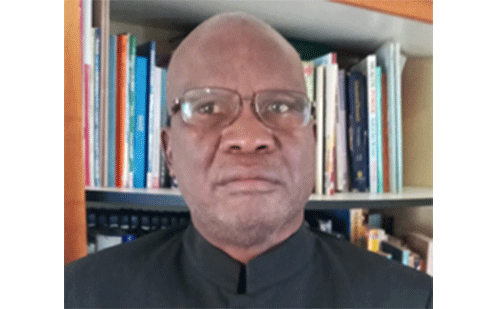
*Prof. Makala Lilemba is an academician, author, diplomat, motivational leader, researcher and scholar.