


Iuze Mukube
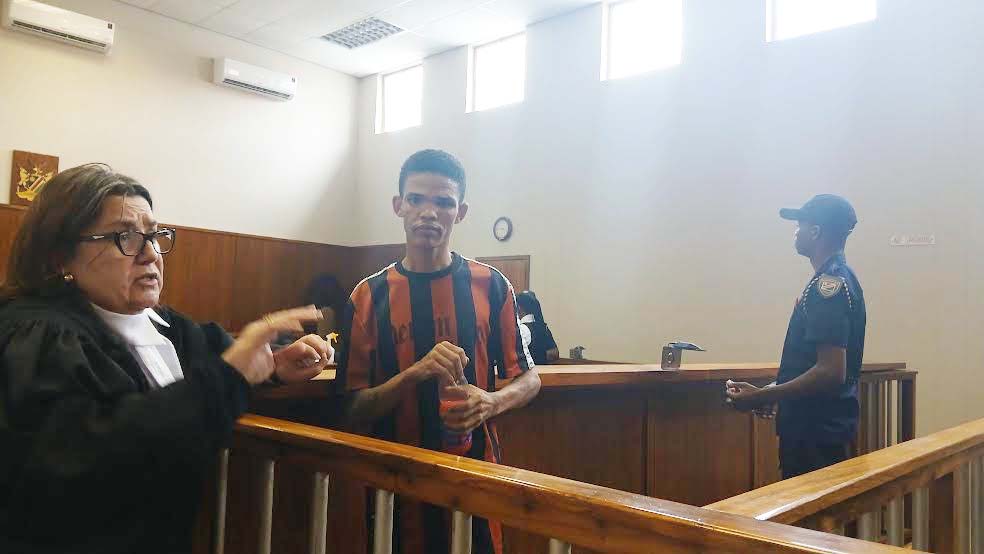
There were no eyewitnesses or forensic evidence linking Adam Isaack to the murder of Eldin Fransman seven years ago at Gibeon in Mariental, according to Windhoek High Court Judge Claudia Claasen.
According to Claasen, the accumulated weight of contradictions, inconsistencies and reliability concerns within the State’s case cast reasonable doubt on whether the accused, rather than another, delivered the fatal stab wound.
“No blood or additional forensic evidence was found on the accused. The investigation of the accused’s clothing produced nothing, and so did the inspection of his body,” said Claasen.
The State’s case is such that this court cannot be satisfied beyond a reasonable doubt that it was Isaack, the judge ruled.
The State had alleged that on 18 June 2019, in the district of Mariental, Isaack unlawfully and intentionally killed Fransman.
It further alleged that Isaack, with the intent to force them into submission, assaulted Fransman and other complainants, Riaan Afrikaner, Josephina Afrikaner, and Willem Swartbooi, by surrounding them with the help of others to prevent their escape, thereby stabbing Fransman in the neck with a knife, which resulted in his death.
The prosecution also indicated that Isaack did so with the intention to steal from the group, a five litre box of wine, which belonged to Fransman.
Isaack was tried on charges of murder and attempted robbery with aggravating circumstances.
Judge Claasen found the State’s case internally contradictory, with unreliable principal witnesses. She noted Afrikaner, who was close to Fransman, was not sufficiently reliable due to limited opportunity to observe the attacker’s face, the mobility of the scene, his drunk state, and observation conditions at about 02h00, which only showed the attacker’s back in disputed lighting.
“This is not a trivial inconsistency, as it goes to the question of who the prime mover in the robbery attempt was. Therefore, it cannot be dismissed as immaterial,” Claasen said.
The court also noted inconsistencies between the oral testimony and the written statement of another State witness, Beneg Jossop.
The judge observed that in his oral evidence, Jossop, just moments before the stabbing, described himself as a mere observer, standing well back from Afrikaaner’s group, whereas his written statement clearly placed him next to Afrikaaner, who was beside Isaack.
“This is not a minor or peripheral inconsistency; it strikes at the heart of the principal issue in dispute. It creates a reasonable possibility that it was the second state witness and not the accused who stabbed the deceased,” said the judge.
She added that the “test is not whether the court believes the accused’s version; it is whether there is a reasonable possibility that his version is true.”
“The accused’s version, while not accepted as an established fact, is at the very least, reasonably possibly true. That is the applicable standard, which entitles him to an acquittal on both charges.”
She added that although Jossop was never charged, if he had been, he might have been considered an accomplice, as not only was he present that evening, but he also owns the knife that caused the fatal stabbing.
Isaack was represented by Janita von Wielligh and the State by advocate Emma Mayavero.
-mukubeiuze@gmail.com