


Abraham Mwanyekange
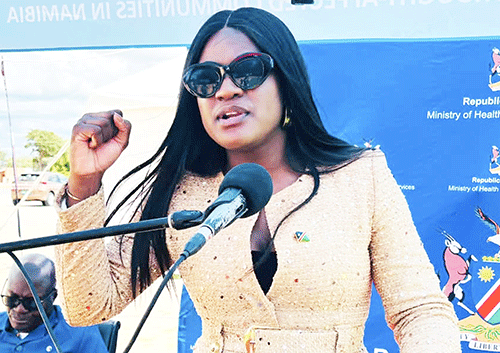
The Minister of Health and Social Services, Esperance Luvindao, has called for urgent national unity to fight malaria.
This is as Namibia faces a sharp rise in cases and deaths.
Speaking during the World Malaria Day 2026 commemoration in Ruacana, the minister said the day must be more than just a ceremony.
“It is a time to reflect, recommit and act,” she said. This year’s global theme is ‘Driven to end Malaria: Now we can. Now we must’, and Namibia’s national theme is ‘Harnessing Knowledge, Prevention and Treatment towards Eliminating Malaria in Namibia’.
These themes both stress the need for strong community action, effective health systems and partnerships.
Ruacana was chosen to host the event due to the high number of malaria cases in Omusati, Zambezi and Kavango regions.
The minister warned that, although communities are trying their best, the situation is getting worse and needs urgent attention. According to the ministry, Namibia aimed to reduce malaria cases to 2 750 by 2025 under the National Malaria Elimination Strategic Plan (2023-2027).
However, cases increased from 13 728 in 2023 to 97 825 in 2025.
In just the first 14 weeks of 2026, 52 068 cases have already been recorded.
The minister confirmed that 61 people have died from malaria this year.
“On behalf of the government, I send condolences to the families. These deaths can be prevented,” she said. Omusati region alone has recorded 6 826 cases, which is 13.1% of the national total. “This shows that our control measures are under pressure,” she added.
Luvindao stated that malaria can be prevented and treated if people seek help within 24 hours after experiencing the symptoms. She said testing and treatment are available but must reach people on time.
She also stressed the importance of mosquito nets and indoor spraying.
Luvindao warned that current methods are not enough and called for a stronger strategy to eliminate malaria by 2030, especially in northern border areas.
She noted that movement between Namibia, Angola and Zambia continues to spread the disease, and urged countries to work together.
The minister said government will strengthen health services, improve supplies and send rapid response teams, but community cooperation remains key. Luvindao pointed out that refusal of indoor spraying and misinformation are making the fight more difficult.
She thanked partners such as Africa Centre for Disease Control, the World Health Organisation, and United Nations Children’s Fund for their support.
“Fighting malaria is a national mission,” she said. “Through unity, awareness and action, Namibia can become malaria-free. Now we can. Now we must,” she stated.