


Heather Erdmann
REHOBOTH– Herbert George ‘Jacky’ Britz was officially coronated as the eighth Kaptein of the Rehoboth Baster Gemeente (community) Traditional Authority on Friday.
This marks a significant milestone after years of leadership disputes and legal processes. The ceremony, held at the Paulus Congregation of the Evangelical Lutheran Church, brought together political leaders, traditional authorities, church representatives and community members from across the country.
Britz’s designation, approved earlier this year by Urban and Rural Development Minister James Sankwasa, follows his election in 2021 after the death of long-serving Kaptein John McNab.
His leadership was later confirmed through court processes, paving the way for formal recognition.
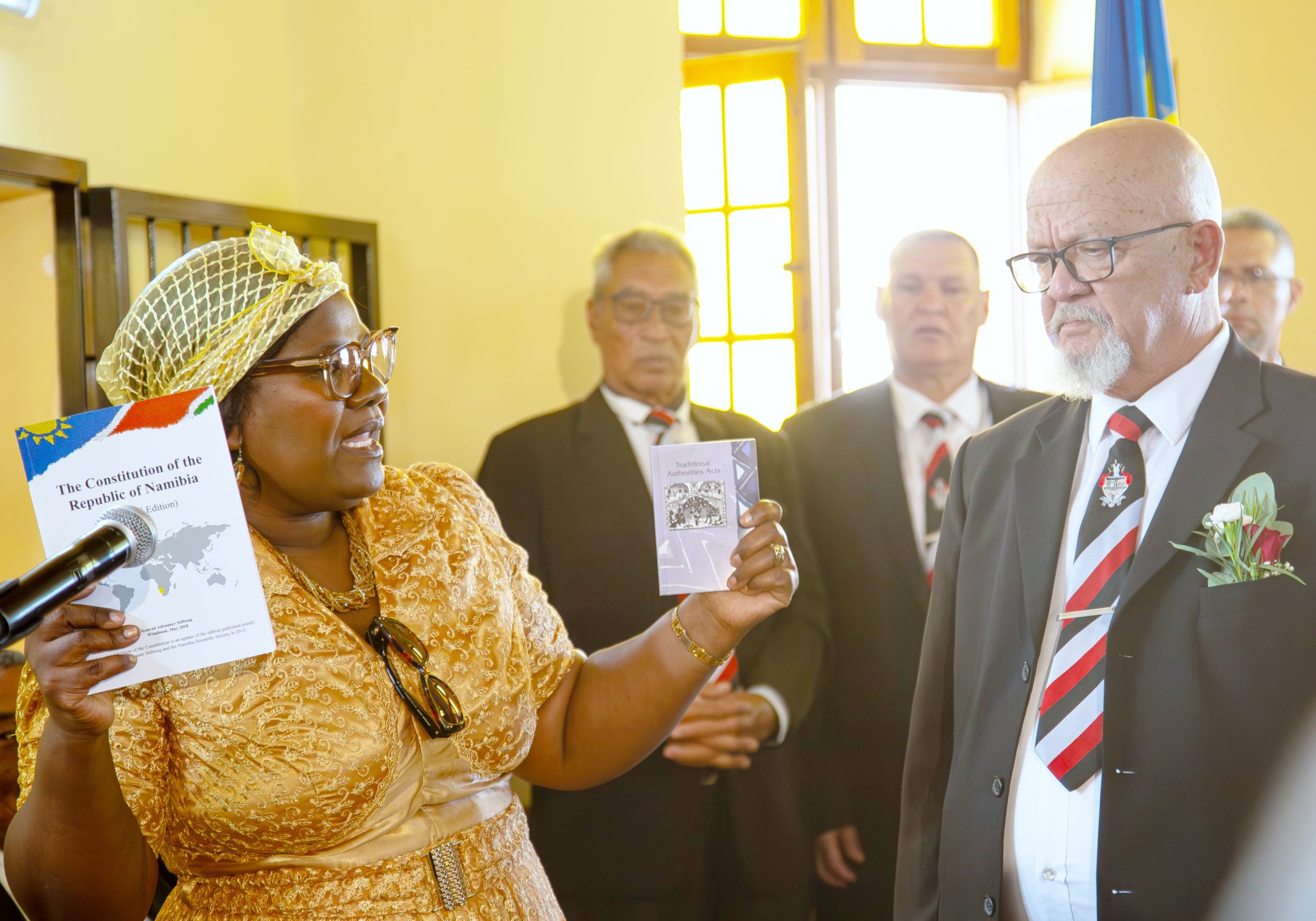
Proceedings blended governance, tradition and faith, with the Kaptein receiving the Constitution of Namibia and the Traditional Authorities Act from Deputy Minister of Urban and Rural Development Evelyn ǃNawases-Taeyele. He was also presented with Die Vaderlike Wette (Paternal Laws), the Baster flag, De Gelofte and a Bible by female clergy members, symbolising the community’s cultural and Christian foundations.
The inauguration also attracted a delegation from the Griqua Royal House of South Africa, led by Kaptein Aaron Messelaar, who described the occasion as a meaningful moment of shared heritage and cultural solidarity between the Griqua and Baster communities.
He said the ceremony reflected deep historical and cultural bonds across borders and underscored the resilience of indigenous identities in the region.
Addressing the gathering, Britz said the occasion represented more than an individual appointment. “This is not about recognising me but recognising the Rehoboth Baster community after 158 years as indigenous people of Namibia, and restoring our dignity,” he said.
He thanked the Namibian government for maintaining peace and stability, saying the community stands ready to contribute to national development.
“We are ready to contribute to peace and stability in our country,” he said.
Britz said his leadership would be guided by service rather than popularity.
“I do not want to be popular. I want to serve my people,” he said.
Calling for unity, he urged the community to move beyond divisions and focus on collective progress. “Forget the past. It is history. The cause is greater than all of us,” he said.
He also called for cooperation among traditional leaders and communities, while highlighting the need to confront social challenges such as gender-based violence, corruption and moral decline.
ǃNawases-Taeyele, who delivered the keynote address on behalf of Sankwasa, called on the new leadership to uphold and preserve cultural values while aligning them with the Constitution. She stressed the importance of collaboration between traditional authorities and government in addressing issues such as land administration, poverty reduction and development. The inauguration also included the swearing-in of the Kapteinsraad (Chief’s Council) and Volksraad (People’s Council), whose members pledged to uphold the community’s laws and work collectively for its advancement. Former mayor George P. Dax described the moment as long overdue, saying the absence of a recognised traditional authority had created challenges for the community.
He expressed confidence that the restored leadership would strengthen development and engagement.
Popular Democratic Movement leader McHenry Venaani said the recognition marked an important milestone in affirming the rights of the Baster community within Namibia.
Retired politician Ben Amathila highlighted the importance of unity and communication, saying cooperation remains essential in building a cohesive nation.
Kapteinsraad member Reverend Stephanus Nell described the inauguration as a “new beginning”, linking it to faith, history and renewal within the community.
Kapteinsraad member Karl Manfred Draghoender emphasised the responsibility of leadership, saying it is rooted in preserving heritage while guiding future generations.
Among those in attendance were Rehoboth mayor Jackie #Khariseb, deputy mayor Crystal Swartz, members of the Rehoboth Town Council, Hardap governor Riaan McNab, Bishop Zephania Kameeta, deputy minister Edward Wambo, representatives of various traditional authorities and community members.
A small group of protesters gathered near the church entrance, forming a corridor as attendees arrived. They expressed dissatisfaction with Britz’s recognition and leadership, although the demonstration remained calm and did not disrupt proceedings.
The ceremony unfolded in a peaceful and dignified atmosphere, marked by prayer, song and cultural expression, with many attendees dressed in traditional attire.
As the event concluded, a strong sense of unity, reflection and renewed purpose was evident, with the community looking ahead to a future anchored in identity, stability and development.