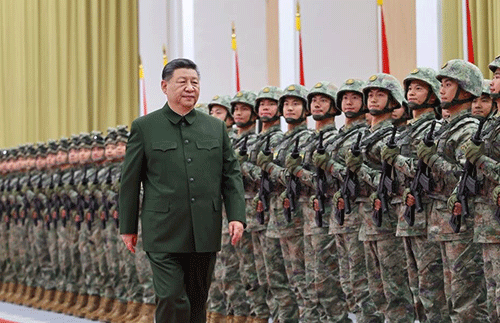

In an era of heightened geopolitical tension and growing insecurity, China this week commemorated the 80th anniversary of the Chinese war against Japanese aggression and the World Anti-Fascist War.
The event here in Windhoek also coincided with the 98th anniversary of the founding of the Chinese People’s Liberation Army (PLA).
Founded in 1927, the PLA has not only become the bedrock of China’s national defence but has also evolved into a prominent global force dedicated to promoting peace, development and multilateral cooperation.
Hosted at the Chinese Embassy here, the ceremony brought together senior Namibian officials, foreign diplomats and military attachés.
Addressing attendees, Chinese Ambassador to Namibia Zhao Weiping said the event marked a moment in history when peace-loving people around the world rose in united resistance against a common enemy, fought bloody battles and achieved victory against fascism 80 years ago.
“The great victory was a historic turning point at which the Chinese nation rose from severe crisis in modern times and embarked on a journey toward great rejuvenation. It was also an integral part of the world’s triumph over fascism,” Weiping said.
He added that China is a peace-loving country.
Quoting his president Xi Jinping, he pointed out that, “since modern times, the Chinese people have suffered over a century of invasion, humiliation and plunder by foreign powers, but what we have learnt from that experience is not the logic of the strong preying on the weak – but rather, we have become even more determined to safeguard peace”.
Speaking at the same event, Chinese defence attaché to Namibia Li Shujun said the PLA continues playing a crucial role in world peace.
“The Chinese PLA is not only a force of strength and victory but also a force of peace,” Shujun said.
Pointing to its collaborations, he said the PLA participates actively in joint responses to global security challenges.
“Over the past 35 years, China has undertaken 25 United Nations peacekeeping missions, deploying over 50 000 peacekeepers in more than 20 countries and regions. Seventeen Chinese personnel have sacrificed their lives for the cause of UN peacekeeping missions,” he said.
Speaking on behalf of the host nation was deputy defence and veterans affairs minister Charles Mubita.
A scholar, ex-Plan combatant and politician, Mubita went down memory lane to the Bandung Conference, held in Bandung, Indonesia, in April 1955.
It brought together representatives from 29 newly independent Asian and African nations to discuss issues of common concern, promote cooperation and foster solidarity against colonialism and neo-imperialism.
The conference is considered a landmark event in the development of the Non-Aligned Movement and a symbol of the growing influence of the Global South on the international stage.
The conference put on paper five principles “that assisted us to achieve our independence. The first principle was political self-determination. The second was recognition of the sovereignty and territorial integrity of each and every country in the world – independent or not.
“Thirdly, it was mutual respect of territories – big or small,” Mubita said.