
Lahja Nashuuta
A relatively new but widely embraced practice is rearing its head across the Windhoek party scene.
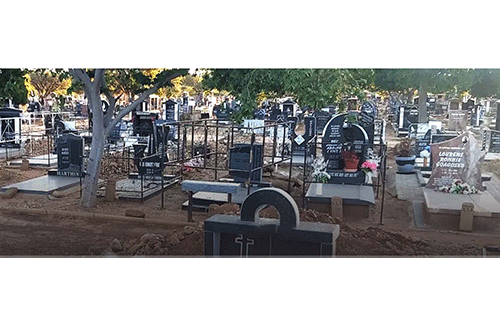
The venue for the merrymaking is not the usual hang out spots of shebeens or bars. Strangely, the loud parties and drinking take place at a place usually reserved for rest – a cemetery.
From the entrance of Windhoek’s Pionierspark Cemetery to the graves, car boots were wide open and music blasted from the large car speakers.
In front of the cars, people drank openly and engaged freely in merrymaking.
The so-called “after tears” parties have become increasingly common in Namibia. People gather after burials to drink, eat and socialise.
While some host these events at the deceased’s residence, others move the party directly to the cemetery, bringing along cooler boxes and camping chairs.
In the aftermatch, the cemetery grounds are left in a shameful state, littered with bottles and cans.
In some communities, such as the Ovaherero and Damara, alcohol is traditionally prohibited at burials.
In other communities, however, the practice is said to be common, as post-funeral tents are often even divided between VIPs and ordinary mourners, both packed with food and drinks.
Posthumous rights
Human rights activist Rosa Namises condemned the practice.
She warned that it violates cultural values and dishonours the dead.
“Even if I’m dead, I still have a right. That right means my resting place must be respected. It should be marked for future reference with proper letters, inscriptions, and, if possible, a proper tombstone, if my family so wishes,” she said.
Namises recalled older traditions where graves were marked with stones.
“We call it kobo kobo – every passerby places a stone to show that someone is buried there. That’s why stones are sacred. They protect the grave and mark it. Today, that respect is disappearing,” she said.
She added, “I have seen people sitting on chairs, with cooler boxes and alcohol, partying over graves. That is total disrespect. A cemetery is not a place of relaxation. It is a sacred space for reflection and remembrance”.
Namises warned that, in the Damara culture, disturbing the dead carries cultural consequences.
“Our elders always taught us that you don’t play, make noise, or collect anything from cemeteries. You walk between graves, and never on them,” she said.
For Namises, the issue goes beyond law and order.
It is about morality.
“The youth are losing their morals and values. When you party at a cemetery, you lose your culture and rootedness. A dead person is sacred. They bring wisdom, protection and harmony. They must rest in peace, and not be disturbed by alcohol and loud music,” she called for collective action.
“The municipality must enforce stricter rules – even arrests – for those who damage or party in graveyards. We must protect our ancestors and preserve respect for future generations,” she remarked.
Elders speak out
Partying or celebrating at a graveyard is strictly forbidden in the Ovaherero culture.
Traditional priest Veruanaije Rukero from Otjiningandu in the Otjinene area said such actions are considered disrespectful and fall under prohibited rituals.
In the Ovaherero tradition, people only visit graves during funerals or other cultural events that are led and guided by elders.
The rituals at the graves, such as the opening of the cemetery, are conducted only by elders who hold the authority to do so.
“The thing of partying at the graveyard is not allowed in our Ovaherero tradition, as it is regarded as prohibited,” said Rukero.
Sharing a similar sentiment, Steven Mujatjirua Tjambiru from Otjitanda village in the Opuwo district said that, in the Ovahimba culture, people cannot go to the cemetery whenever they want.
The cemetery is only visited during funerals or on special occasions when the community gathers to commemorate and pay homage to the dead.
“You cannot just go to the cemetery anytime you wish. We only go there for funerals or when commemorating and paying homage to the dead. The celebration of their life is done at home, while the cemetery is strictly for cultural rituals,” Tjambiru said.
Elcin’s Rev. Mathew Tshapaka Tshakapolo called the practice a distortion of tradition and an outright insult to the dead.
“In Oshiwambo, there is a saying: ‘iihuna yomuntu oyi vule yombwa’, which literally translates as ‘the human transgression is worse than that of a dog’. This practice reflects confusion and ignorance. You cannot allow an after-tears party at your parents’ burial. It is insane and even more insane when done at the grave,” he said.
Tshakapolo urged elders and churches to provide more guidance.
“Spiritual leaders must counsel communities during memorial services, and families must teach their members about respect and human dignity. After burial, the spirit has entered eternity. There is no need for further engagement unless it is remembrance or culturally sanctioned ceremonies,” he added.
Legal stance
On the regulatory side, City of Windhoek spokesperson Lydia Amutenya confirmed that the municipality has both the mandate and the responsibility to regulate conduct at cemeteries.
She said the City’s authority originates from the Local Authorities Act, 1992 (Act No. 23 of 1992), which gives councils wide-ranging powers to ensure order and dignity in public spaces, including burial grounds.
“The City of Windhoek has the legal duty to protect cemeteries as places of peace, remembrance and respect,” Amutenya said. “Our cemeteries are not just pieces of land. They are sacred spaces, hallowed grounds that carry emotional and cultural value. The law is very clear – no nuisance, no disorder, and no misuse of these areas will be tolerated,” she said.
The Cemetery and Crematorium Regulations of 1999, enacted under this Act, prohibit activities such as creating a nuisance, which covers disturbances, including excessive noise, disruptive parties, or any conduct that undermines the solemnity of the cemetery.
Another provision prohibits the unauthorised use of grounds.
This means that cemeteries may not be used for purposes outside their intended function, including alcohol consumption, parties or entertainment-related activities.
She said that the law provides enforcement mechanisms: the chief of parks, recreation and cemeteries, or any authorised officer, has the power to remove offenders on the spot.
Those found guilty of violations face fines of up to N$2 000 or imprisonment of up to six months.
Amutenya stressed that these provisions reflect a broader principle applied to all City-managed spaces.
The Park Regulations of 2009, for example, also forbid excessive noise, alcohol consumption and disorderly conduct in recreational areas.
This creates a uniform standard of conduct across Windhoek’s public properties – whether they are leisure parks or cemeteries.
“The City’s position is clear,” she said.
“Public spaces must remain orderly and dignified. Cemeteries, in particular, deserve the highest level of respect, because they are not just municipal property but the final resting places of our loved ones. Hosting entertainment events at gravesites undermines cultural values, causes distress to other mourners, and directly contravenes the law,” Amutenya asserted.
– lnashuuta@nepc.com.na