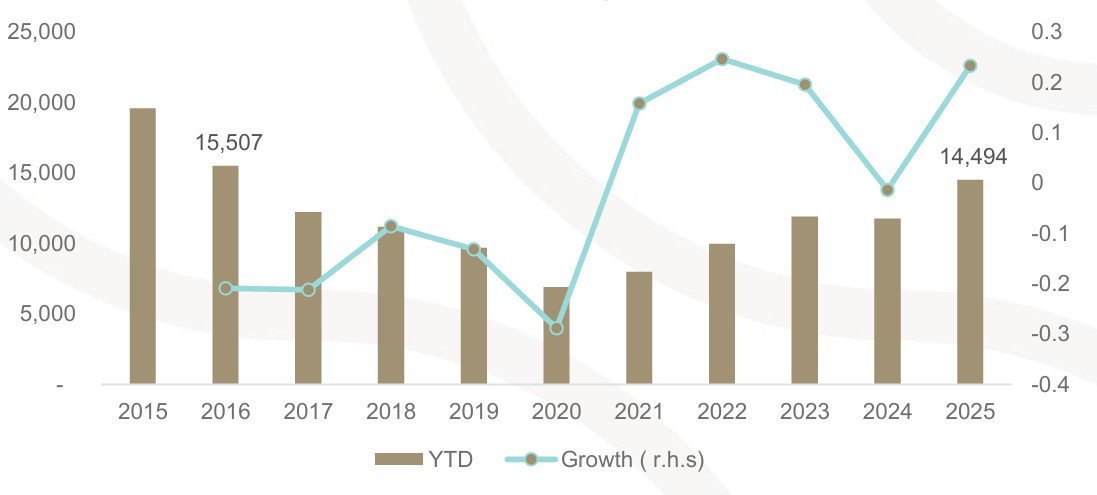

Namibia’s vehicle market heads into 2026 at a decisive inflection point, marked by a cooling but healthier credit cycle, a gradually easing monetary policy stance, and deepening structural shifts in the regional automotive landscape.
In its analysis of the latest vehicle sales figures, financial services firm, Simonis Storm (SS), noted that while headline sales momentum softened toward the end of 2025, the underlying fundamentals suggest the sector is transitioning from a sharp cyclical rebound into a more durable, value-driven phase of expansion.
Looking ahead, Namibia’s vehicle market in 2026 is best described as measured but structurally constructive.
Monetary easing and improving credit conditions provide cyclical support, while fleet-driven demand anchors volumes. At the same time, the rise of Chinese manufacturing introduces a lasting structural force that is expected to reshape competition. In its number’s analysis, SS stated that the next phase of the market will be less about rapid rebound and more about adaptation to new economics, where value, localisation, and cost efficiency determine the winners.
Vehicle sales ended 2025 on a softer note, with December volumes falling to 1 138 units, an 8.5% month-on-month decline from November and well below the March 2025 peak of 1,320 units. SS stated that this moderation should not be misread as a reversal as December sales were still 13.8% higher than a year earlier, and total sales for 2025 reached 14,498 units, the strongest annual outcome since 2015.
Compared with 2024, volumes surged by more than 70%, firmly establishing 2025 as a recovery year rather than a short-lived rebound. SS further noted that the fourth quarter was particularly telling. Total sales of 3 649 units marked the strongest fourth-quarter performance since 2016, underscoring the breadth and resilience of the upswing. Importantly, sales dipped below the 1 000-unit threshold only once during the year, highlighting how elevated activity has become relative to recent history. SS added that from a macro-financial perspective, conditions remain broadly supportive as Private Sector Credit Extension (PSCE) slowed marginally to 4.5% year-on-year in November 2025, reflecting softer household and corporate borrowing.
However, this moderation signals stabilisation rather than stress. Credit growth remains well above the subdued levels of 2023 and early 2024, indicating that lending conditions are no longer a constraint on economic activity.
Monetary policy adds another layer of support, as SS pointed out, with inflation expected to remain contained, the Bank of Namibia has scope to continue easing policy in line with South Africa. SS emphasised that two additional 25 basis-point repo rate cuts in 2026, which would take the policy rate to 6.0%, are widely anticipated. “While lower rates are unlikely to spark a fresh surge in vehicle demand, they will incrementally improve affordability, support instalment credit uptake, and reinforce the foundations for sustained sales growth,” the SS report states. Meanwhile, demand dynamics within the market are becoming increasingly segmented. Instalment and leasing credit linked to vehicle purchases continues to outperform other lending categories, driven largely by corporate demand. Fleet investment across logistics, agriculture, mining, tourism, and energy-related services has been the backbone of the recovery. Household demand, by contrast, remains cautious as elevated living costs and rising ownership expenses constrain discretionary spending. SS noted that this divergence was evident in December’s sales mix.
Passenger vehicle sales rose 6% month-on-month and were 5.7% higher year-on-year, suggesting some resilience in consumer demand. Commercial vehicle sales fell sharply on a monthly basis, down 18%, but still posted positive annual growth of 1.5%.
Historically, commercial vehicle sales lead the broader economic cycle by roughly a year, implying that the strength seen through most of 2025 bodes well for activity in 2026.Within the commercial segment, light commercial vehicles continued to dominate, with 535 units sold in December, up 6% year-on-year. Medium commercial vehicles recorded strong percentage growth from a low base, while heavy and extra-heavy segments contracted sharply, reflecting deferred fleet replacement amid uncertainty around large-scale construction and infrastructure execution.
The construction sector remains a key upside risk: final investment decisions on green hydrogen and offshore oil and gas projects could materially lift demand for medium and heavy trucks.
According to SS, overlaying these cyclical trends is a powerful structural shift reshaping Namibia’s vehicle market, particularly with the rapid ascent of Chinese automotive brands. Their growing influence across southern Africa, exemplified by Chery’s planned acquisition of Nissan’s Rosslyn plant in South Africa, signals a fundamental realignment of supply chains. Increased localisation by Chinese manufacturers is likely to shorten delivery times, stabilise supply, and enhance pricing competitiveness—critical factors in a market increasingly defined by affordability and total cost of ownership.
Brand data already reflects this transition. In December, Chinese brands lifted market share to 11.5%, up from 9.8% in November, with Haval leading the segment. For the full year, Chinese brands sold 1 320 units, raising market share to 9.1% and placing Haval among the top five brands for the first time.
Chinese manufacturers are no longer fringe players; they are becoming entrenched incumbents shaping pricing benchmarks and competitive dynamics.