


Matheus David
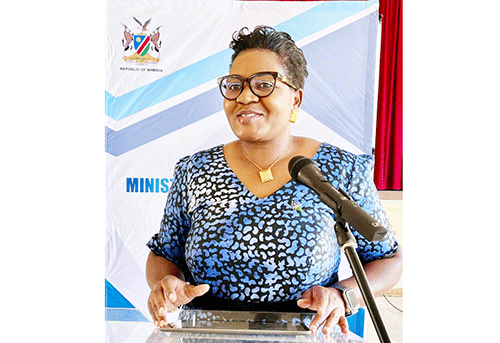
Gender Equality and Child Welfare minister Emma Kantema on Monday called on staff to renew a culture of “business unusual”, urging faster implementation, compassion in service delivery, and unity within the ministry.
During the 2026 official staff briefing in Windhoek, Kantema acknowledged the often-invisible sacrifices made by public servants working on the frontlines of gender equality and child protection.
“You are not just names on an organogram. You are the backbone of this ministry. You are valued. You are seen, and you matter,” she said.
Drawing from her own experience in public service, the minister said the work of the ministry was not ceremonial but deeply personal and nation-building, touching the most vulnerable spaces of Namibian society, from survivors of gender-based violence to children in need of care and protection.
Formulating the year’s agenda, the minister challenged staff to live out the principle of “business unusual”, explaining that it does not mean chaos or burnout, but rather decisive action, accountability and measurable results.
“When a citizen knocks at our door, we must not respond with excuses. We must respond with service,” she said.
Quoting President Netumbo Nandi-Ndaitwah, Kantema reminded staff that public office is not a place for personal comfort or enrichment but a platform for service. “A citizen is not an interruption of our work,” she said.
“A citizen is our work.”
She motivated the staff to go beyond minimum requirements, adopt a problem-solving mindset, and ensure that no citizen is passed from office to office without support or follow up. Kantema based the ministry’s work on national and global development frameworks, including Vision 2030, NDP6, the SDGs and the ministry’s strategic plan 2025–2030. She described the strategic plan as a living tool for decision-making rather than a document for shelves.
The plan highlights persistent challenges such as gender-based violence, violence against children, harmful social practices, limited resources and gaps in data for evidence-based planning.
Furthermore, the minister acknowledged progress made in early childhood development, residential childcare, educator support and Namibia’s strong global standing on gender equality.
Looking ahead, she identified key priorities for 2026, including strengthening gender mainstreaming, improving child protection systems, engaging men and boys, enhancing legislative frameworks, and building a high-performance culture rooted in integrity, accountability and compassion.
Performance, she said, should not be feared. “We are not building a culture of punishment,” she said. “We are building a culture where people are supported to succeed.”
Kantema called on managers to lead with fairness and empathy while encouraging staff to pursue growth, skills development and leadership opportunities.
“If we are united, we are faster. If we are united, we are stronger,” she said.
“Let 2026 be the year we are known not only for caring but for delivering results that can be felt in homes, communities and children’s lives.”