


Namibia’s economy is forecast to grow more rapidly over the next decade, primarily due to mining and the emerging oil and gas sector, as the country’s economic outlook continues to improve.
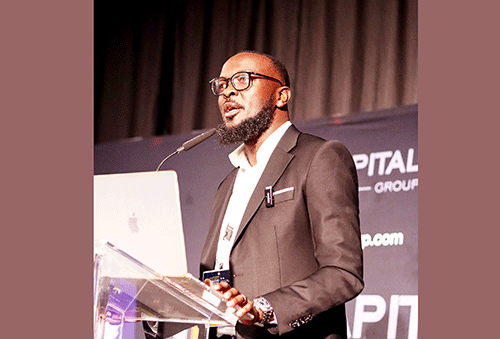
Jason Kasuto, managing director of Monasa Advisory and Associates, expressed during the Namibia Institutional Investors Forum 2026 recently, in the capital, that stronger domestic economic growth is imminent.
“We forecast that real GDP growth in Namibia will average 6.1% between 2026 and 2035, which is well above the 2015–2024 average of 1.3%, with structurally higher growth being driven by the continued expansion and development of Namibia’s mining and emerging hydrocarbons sectors,” Kasuto said.
The forum brought together pension funds, asset managers, development finance institutions and policymakers from across Africa. Discussions focused on how large pools of institutional capital can support sustainable economic growth and development projects in Namibia and the wider region.
Held under the theme “Mobilising Institutional Capital for Sustainable Growth and Regional Impact,” the event explored ways to channel long-term investment into infrastructure, renewable energy, and other productive sectors of the economy.
Monasa Advisory and Associates participated as a strategic partner at the event. The firm contributed to discussions on capital allocation, environmental, social and governance (ESG) integration, infrastructure financing, energy transition and industrialisation.
A key focus of the forum was how institutional investors, such as pension funds, can move beyond traditional investments to help finance large scale development projects.
Among the largest asset owners taking part was the Government Institutions Pension Fund, which manages billions of Namibian dollars in savings on behalf of public servants.
Kasuto reflected on recent global uncertainty and geopolitical tensions in the Middle East that have affected global markets, stating that at Monasa Advisory and Associates, they believe that ‘transformation starts from within.’
Today, that means recognising that, as a nation, we are dependent on global volatility, a direct result of our slow pace of structural diversification.
“As we watch fuel under-recoveries mount and global supply chains tighten, the mandate for this forum becomes even more crystal clear: we cannot afford for our capital to be passive,” he said.
He further emphasised the importance of building local capacity across the continent and within Namibia, stating that their vision for Namibia, and indeed for Africa, cannot be anchored in the hope that global markets remain calm. It must be anchored in the reality of building local capacity.
Kasuto urged investors to rethink how institutional capital is deployed. To move from fiduciary duty to fiduciary courage. They must deploy capital into projects that turn our resources into finished or semi-finished products, students into specialised technicians, and SMEs into regional and global suppliers.
“Let’s think out of the box, shifting from talking narrowly about ‘risk-adjusted returns’ to thinking more about ‘resilience-adjusted returns.’ Let us decide that Namibian savings will be the primary engine that drives us toward Vision 2030, regardless of the winds blowing from the North or the Middle East,” he said.
-pmukokobi@nepc.com.na