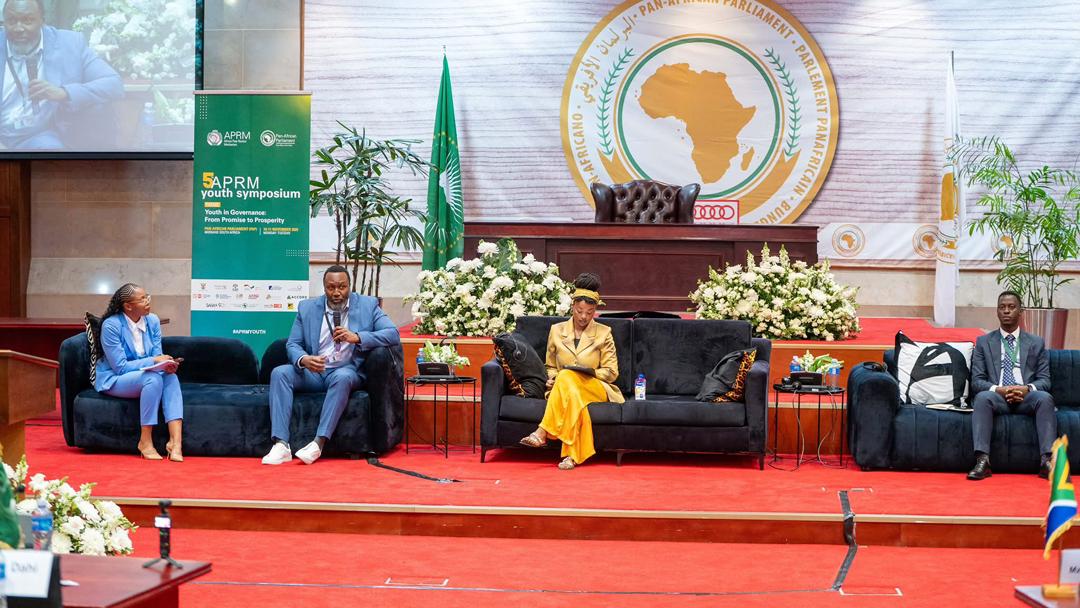

Landless People’s Movement (LPM) youth leader Duminga Ndala stated that in Namibia, good governance means access to economic opportunities for youth, efficient and improved service delivery, and public institutions that are accessible, trustworthy, and free from corruption.
Ndala, the chairperson of the LPM Youth Command Element, emphasised that this shift would make young people not just beneficiaries of development but also active contributors and equal stakeholders in shaping national priorities and promoting good governance for a new Namibia.
“Many African nations today are experiencing what we can call transition fatigue — systems that once promised liberation, transformation, and renewal have struggled to evolve beyond their founding missions,” said Ndala on the sidelines of the African Peer Review Mechanism (APRM) Youth Symposium in Midrand, South Africa.
The APRM is a specialised agency of the African Union and the continent’s primary self-monitoring and peer review tool for promoting good governance.
It facilitates good governance by promoting adherence to norms of conduct contained in the African Charter on Democracy, Elections and Governance. The Mechanism exists as a voluntary exercise among African Union States to systematically assess and review governance at the level of Heads of State.
Ndala noted that Africa’s governance frameworks are often outdated and misaligned with the current needs and aspirations of the continent’s youth majority.
“We have young people trying to live, innovate, and thrive in structures designed decades ago for a different generation with different challenges. Therefore, these systems frequently fail to reflect the lived realities of young people, especially those grappling with unemployment, inequality, and rapid technological change,” she expressed.
Ndala’s discussion at the symposium focused on whether African youths are winning the battle for good governance or fueling youth anger and disillusionment.
“This comes at a time when we are witnessing an upsurge of Gen Z-led movements demanding transparency, accountability, and good governance. We have witnessed the protests in Kenya where young people were protesting the Finance Bill of 2024,” she recalled.
Ndala recalled the recent Madagascar protests where young people began demonstrations in the capital Antananarivo, and five major cities on 25 September. They were angered by incessant power outages and chronic water shortages, demanding that then-president Andry Rajoelina step down. Rajoelina has since fled into exile, and the country now has a new president, Colonel Michael Randrianirina.
“The Gen Z 212 movement in Morocco is demanding that national priorities reflect public needs (hospitals) over prestige projects (sports stadium). These are not isolated events but a reflection of a broader systemic failure to address the deep-rooted class and generational challenges facing young people across the continent,” she said.
Ndala observed that in each case, young people are calling for transparency, accountability, inclusion, and meaningful participation not as passive partners, but as central actors in shaping the socio-economic and political realities of their nations.
“Young people are disillusioned, more than ever. We have a high unemployment rate on the continent, and the inequality rate amongst young people is wider and continues to grow. This is a result of poor governance, transition fatigue, and a lack of prioritising the needs of young people,” said the researcher.
-psiririka@nepc.com.na