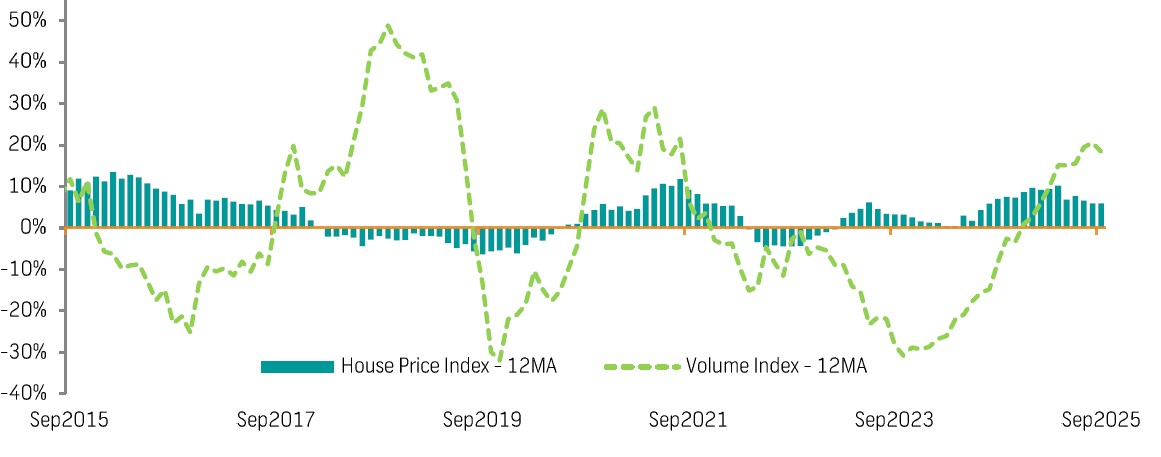

Namibia’s house price index shows that house prices grew by an average of 5.9% in the third quarter of 2025 (3Q25).
This is slower than the 7.7% growth seen in the previous quarter (2Q25) and the 7.0% recorded in the same period last year (3Q24). Even with the slowdown, the housing market remains strong and stable, having emerged from negative growth in early 2023, according to the latest FNB House Price Index Report.
Market Research Manager Mandisa van Wyk said, growth across different property sizes varied widely. Small homes grew by 4.4%, medium-sized homes by 0.3%, and large homes by 1.9%, while luxury homes experienced a sharp decline of 23.9%. From a regional perspective, all areas reported price increases. The northern region led with a 10.9% rise, followed by the southern region at 8.5%, the central region at 4.8%, and the coastal region at 1.2%.
“The average national house price now stands at N$1 380 042, up from N$1 360 664 in 2Q25 and N$1 303 179 in 3Q24. Regionally, the average price in the central region is N$1 738 000, followed by the coastal region at N$1,477,000, the northern region at N$975,000, and the southern region at N$923, 000,” she said.
She added that, despite slower price growth, demand for housing remains strong. More properties are being bought and sold, with transaction volumes rising by 18.4% in 3Q25 compared to 15.5% in 2Q25.
“This is a big turnaround from a drop of 8.2% recorded a year ago. Regionally, transaction volumes grew by 12.1% in the central region, 41.5% at the coast, 11.8% in the north, and 33.3% in the south. However, the southern region still makes up only a small part of total transactions, with just 27 out of 892 recorded during the period,” she said.
On the lending side, household mortgage credit growth slowed to 0.6% year-on-year in September 2025, down from 0.8% in August. This suggests that fewer people can borrow money to buy homes, and wealthier consumers are making most purchases with stronger financial backgrounds.
To support the economy, which grew only 1.6% in the second quarter of 2025 compared to 2.8% in the first quarter, the Bank of Namibia reduced the repo rate by 25 basis points to 6.50% in October. Inflation also eased during the quarter, averaging 3.6%.
Van Wyk further added that, looking ahead, growth in the FNB House Price Index may continue to moderate, following two consecutive quarters of easing house price growth. Nevertheless, transaction volumes continue to outperform, underpinned by strong housing demand despite persistent supply constraints.
Base effects from the previous year may also be influencing current dynamics, as in 3Q24, price growth rose to 7.0%, while transaction volumes declined by 8.2%. In contrast, 3Q25 saw price growth slow to 5.9%, while transaction volumes surged to 18.4%, driven by increased foreign interest and rising investment in rental properties.
To improve housing market access, proactive municipal efforts to accelerate land servicing could significantly expand property ownership opportunities for a broader segment of the population.
-pmukokobi@nepc.com.na