

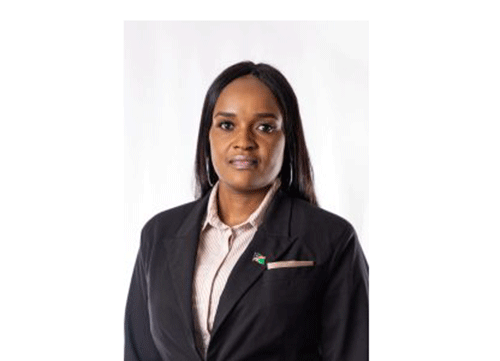

Rudolf Gaiseb
The Legal Aid income threshold is outdated, leaving those in need of legal representation out in the cold.
This was highlighted by Swapo parliamentarian Hilma Iita, who tabled a motion last week proposing 75% partial legal aid assistance for middle income earners to enable them to access justice.
Iita highlighted the “justice gap” affecting citizens earning around N$7 000, the current income threshold for legal aid. She said the threshold is outdated, leaving many “middle-income” workers unable to afford private lawyers who charge up to N$50 000 for complex cases.”
“They are not rich, and they are not privileged; they are ordinary working people. These include the security guards, the junior civil servants and many others who are trying to make ends meet, yet when they need legal assistance, they are told, ‘You earn too much to qualify for legal aid,’ and at the same time, they are told, ‘You earn too little to afford a lawyer,’” she justified.
She stressed that the cost of just opening a file with a private legal practitioner can be as high as N$7 000, and it also depends on the complexity and the nature of the case; it might go up to N$50 000, which makes legal services completely out of reach for many. She emphasised that this is not just a policy gap; it is a justice gap, and that gap directly undermines the guarantees set out in the Constitution of the Republic of Namibia, including the rights to equality before the law and to a fair trial.
In the middle of 2024, the Ministry of Justice raised the income threshold for legal aid eligibility from N$3 500 to N$7 000 per month. But Justice minister at the time, Yvonne Dausab, a few months later, remarked they had planned to raise this threshold to N$10 000 so that more people can make use of the service.
Dausab told a local newspaper that the law needs to be changed so that legal aid considers not only a person’s income but also the nature of the case. However, Iita emphasised that the law remains unchanged and is now outdated and unprogressive for middle-income earners. She urged the current Minister of Justice, Fillemon Wise Immanuel, to urgently review the increase in the income threshold to reflect the current cost of living. “If this gap is not closed, then we are not merely underfunding a direct threat; we are undermining the very foundation of the rule of law,” she said. Prime Minister Elijah Ngurare described the suggestions to review the income threshold and provide partial legal assistance as “spot on”. He said that the justice system should not function like a “spider web” that “catches only small flies” while “big birds fly through”.
“I think it is very clear that we should not only see this benefiting some and not others; everybody should have access to justice,” he said.
-rgaiseb@nepc.com