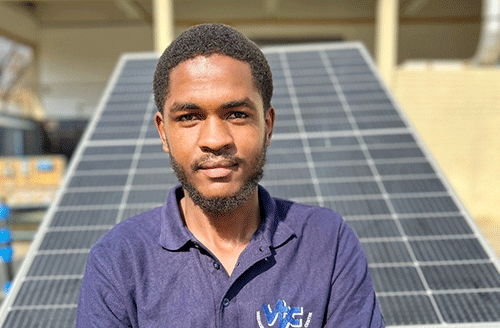

Solar Technician Kevin Kevanhu (20) has a deep interest in green technology, innovation and the role of Technical and Vocational Education and Training (TVET) in driving Africa’s sustainable growth, particularly in Namibia.
Born in Outapi, he chose the TVET route because he strongly believes that practical skills are key to Africa’s sustainable transformation.
His goal is to help drive Africa’s transition to renewable energy, ensuring that no one is left behind.
“I came to understand that energy access is not just a technical issue, but a matter of social justice. This was during the period when I was deciding on a career path, and discussions around Green Hydrogen and renewable energy were gaining momentum,” he shared during a podcast session on RDJ.
RDJ Publishing is the publishing home of the ‘Energy & Sustainability Africa’ (ESA) – a monthly publication written and authored through collaboration with RDJ Consulting Services CC, based in Windhoek, Namibia.ESA publication focuses on Africa’s Energy and Sustainability space by providing current information on the developments, opportunities, challenges and key stakeholders.
The passionate technician’s work focuses on community development, renewable energy education and advocacy for youth participation in the energy sector.
“My interest began when I saw how rural communities struggled without electricity and by witnessing the severe energy poverty that continues to affect rural Africa, particularly in Namibia.
“Many communities remain underdeveloped because they lack access to electricity, a basic need for progress. For me, solar energy represented a clear, decentralised and practical solution to this challenge,” shared Kavenhu, who specialises in installation and maintenance at VTC.
He said: “Solar energy is the backbone of Africa’s sustainable future, as it eliminates the need for expensive grid expansion by providing off-grid and mini-grid solutions that can electrify rural communities within months. These systems power essential services such as schools, clinics and water pumps, directly improving livelihoods”.
Kavenhu shared that his advocacy directly supports Agenda 2063, ‘The Africa We Want’, which envisions a prosperous continent founded on inclusive growth and sustainable development.
It aligns with Sustainable Development Goal (SDG) 7, Affordable and Clean Energy and SDG 13, Climate Action, by promoting renewable energy access and raising awareness on sustainability across Africa.
He sees renewable energy as the foundation for achieving inclusive growth and for realising the Africa that is desired.
He added that the COP30, which is held in Brazil this year, reinforces these commitments by calling on young people and policymakers to act together in delivering a just and sustainable energy transition.
“To scale renewable energy, Africa needs a holistic approach involving both policy reform and infrastructure investment. Governments should simplify power purchase agreements, licensing and approval processes for renewable projects. Incentives such as tax relief and low-interest financing can encourage innovation and private sector participation,” he said.
Kavenhu has called for the investment in TVET training and technical education, as without skilled engineers and technicians, projects struggle to last.
“Infrastructure priorities should include Grid reform, smart grid construction, energy storage systems and local manufacturing of solar components to reduce import costs. I believe renewable energy should not only be viewed as an environmental goal, but also as a development and employment strategy,” said Kevanhu.
-psiririka@nepc.com.na