

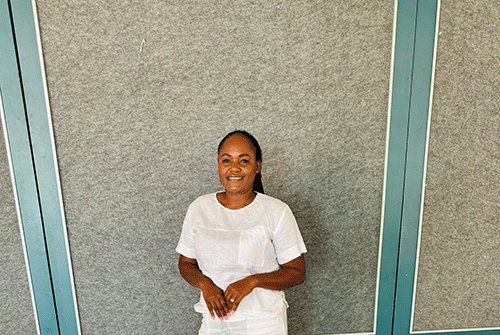

Loide Nghiishililwa began her teaching career at a young and energetic age of 22, in January 2013, as an English Second Language and Oshindonga First Language teacher in the Khomas region at Acacia High School.
Her love for teaching and education led her to concurrently teach at Namibia College of Open Learning (NAMCOL) as a part-time tutor for English Grade 10 and Grade 12, whilst also tutoring part-time for English for Communication purpose, before becoming the Head of Centre for NAMCOL in 2016 at the same school where she taught as a full-time teacher.
She was later promoted in August 2017 as a Senior Education Officer (Subject Advisor) for English First and Second Language, as well as Oshindonga First Language in Otjozondjupa region until July 2023 before joining the National Institute for Educational Development (NIED) where she serves as a chief education officer heading the
sub-division for European Languages, under the Ministry of Education, Innovation, Youth, Sports, Arts and Culture.
Achievements
Nghiishililwa commended the government on the progress it has made on school infrastructure upgrades, new classroom construction, and maintenance.
“I would say there is great progress regarding school infrastructure, construction of new classrooms, and maintenance of aging facilities. We are not where we want or should be, but we are definitely not where we started,” she said.
The educator shared more of the ministry’s achievements.
“The ministry prides itself on the successful implementation of the Jolly phonics programme, which is a systematic phonics tool designed to teach children how to read and write in a fun and enjoyable way,” she said.
“It is also worth noting a significant improvement in results performance in both Namibia Senior Secondary Certificate Ordinary level. (NSSCO) and AS levels in 2024 compared to 2023, and more learners qualifying for AS level despite navigating repercussions of the Covid-19 which disrupted effective teaching and learning,” she added.
Educational challenges
Nghiishililwa said, despite finding her job fulfilling, it’s not without challenges.
“The biggest challenge facing the Namibian education system is the lack of enough classrooms, leading to overcrowded classrooms, thus affecting the teacher-to-learner ratio. This is a serious concern because teachers are unable to give individual attention to every learner, which, to an extent, may lead to teachers being burnt out,” she shared.
She acknowledged thatthe government is doing its utmost best in addressing this challenge by allocating funds annually for classroom constructions and building new schools.
“In some cases, temporary structures are put up and have two streams’ systems were some learners start in the afternoon after the morning group is out. All these efforts ensure that the government meets its pillar of access to school to all the Namibian children,” said the educator.
“The Namibian nation needs to understand that this is not a sole responsibility of the government, but as citizens of our country, we should all pull in one direction and try to meet the state halfway,” she said.
Additionally, she said that the business community and the Non-Governmental Organisations should continue to give back to the community.
Teacher-learner ratio
Nghiishililwa shared that the teacher shortage coexists with qualified unemployed teachers because of oversupply in certain subject areas and phases.
“The shortage of teachers, especially in rural areas, can be attributed to the qualified teachers being reluctant to move to remote areas due to a lack of proper or adequate housing for staff. The government has already provided a bush allowance as an incentive to attract qualified teachers in remote areas,” she said.
“Teacher training programmes have been introduced to eliminate the lack of qualified teachers especially in subjects like Afrikaans, Khoekhoegowab, and the Junior Primary phase, where teachers are offered grants to obtain a teaching qualification with the University of Namibia,” she said.
Additionally, Nghiishililwa said through the National Institute for Educational Development (NIED), the ministry of education continues to offer in-service training and continuous professional development annually.
On the learning material and technology, Nghiishililwa explainedthat the Namibian government, through the ministry of education, remains dedicated to providing quality education.
“It is not a secret that the ministry receives the biggest chunk of the budget annually, catering for textbooks procurement, classroom renovation and construction, upgrading existing infrastructure such as abolition facilities, hostel rooms, laboratories, etc,” she noted.
“As I have reiterated, we need to be a responsible nation and not shift the entire blame to the government. We all need to play our roles. For example, textbook officials and school managers should have policies in place that are effectively implemented in recovering lost textbooks to avoid a recurring cycle of procuring the same items or textbooks every financial year due to negligence,” said Nghiishililwa.
She urged that learners and communities at large be sensitised to the importance of preserving our infrastructure and to refrain from vandalising government property.
-lmupetami@nepc.com.na