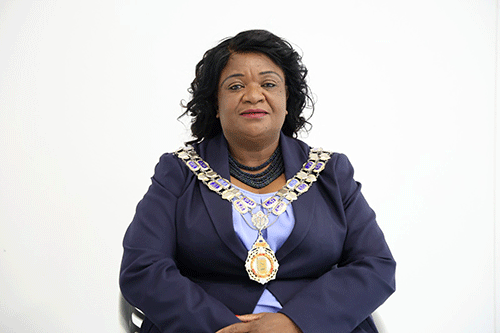

Outgoing Windhoek mayor Ndeshihafela Larandja said through teamwork and stronger partnerships, the city made progressive deliverables for the year.
She highlighted improvements in informal settlements, including the city extending electricity, adding more water points and sanitation facilities, continuing mapping of structures to support service access, and upgrading roads, as some of the achievements.
In an exclusive end-of-term interview with New Era last week, Larandja said the achievements show a new kind of leadership, one she described as “a city that listens.”
Under her leadership, the mayor’s office launched a Clean Skip Competition that trained 244 community members in waste management and encouraged ward-level participation.
She also oversaw the Backyard Gardening Project, which aimed to address food insecurity.
Fifty-five residents were trained and given starter kits, with each expected to train five others in their areas.
One of her most emotional achievements, she said, was delivering a modern sanitation hub at Babylon informal settlement.
“Residents cried for dignity. They shared one toilet per household. They spoke, and I listened. We built and handed over the first modern sanitation hub with eight toilets and two urinals. That is leadership that responds to dignity,” she said. Other achievements include extending municipal debt relief to vulnerable groups such as people with disabilities, child-headed households and orphanages, and opening the door for businesses to return to Ramatex, which had stood idle for years.
Challenges
Larandja admitted that serious governance challenges still remain.
She pointed to the abuse of delegated powers, saying some officials and councillors overstepped their roles.
She also raised concern about unlawful decisions passed “in the name of the majority”, which she believes undermined the rule of law.
Another major challenge, she said, is the political competition between central, regional and local government, which she believes wastes resources and confuses residents about who is responsible for what.
She said years of partisan battles have created mistrust in the council, making it difficult to lead and implement policies smoothly.
According to her, city’s last five years were marked by deep political division, sabotage, and weak cooperation between government structures. She said the situation slowed service delivery and created what they call “a nightmare council”.
Larandja said the coalition council of six parties entered office with hope but soon crashed into the reality of inexperience and ideological conflict. “The first three years were years of a nightmare,” she said.
“Most councillors were new, the political ideologies were different, and the levels of understanding were not the same. It caused misunderstanding, division and instability,” she stated. According to her, these battles consumed time and energy that should have gone into fixing water, land, sanitation, traffic and housing challenges.
Larandja also criticised the lack of cooperation between central, regional and local government.
“There is no cohesion between the three tiers of government. Instead of working together, it often feels like competition. But this competition harms service delivery. The people suffer when leaders fight,” she said.
She stated that the result was delayed decisions, duplicated projects and poor coordination on major development matters.
Larandja did not shy away from describing the council as deeply partisan.
“Partisan politics is the main weapon of destruction in the council. It kills morale, creates indecision and even gives room for some officials to manipulate council divisions,” she described.
She said officials sometimes saw the political chaos as an opportunity to push certain interests through selected councillors.
Seats
Larandja recalled 2022 as a turning point when she opposed what she believed was an irregular CEO appointment supported by the majority.
“I called a press conference to inform the public what had happened. The 11 councillors who supported the appointment were not happy. After that, a vote of no confidence removed all IPC councillors from the management committee,” she said.
She said IPC also faced backlash when it publicly revealed the city’s “negative financial position”, something she maintains was necessary for transparency.
-ljason@nepc.com.na