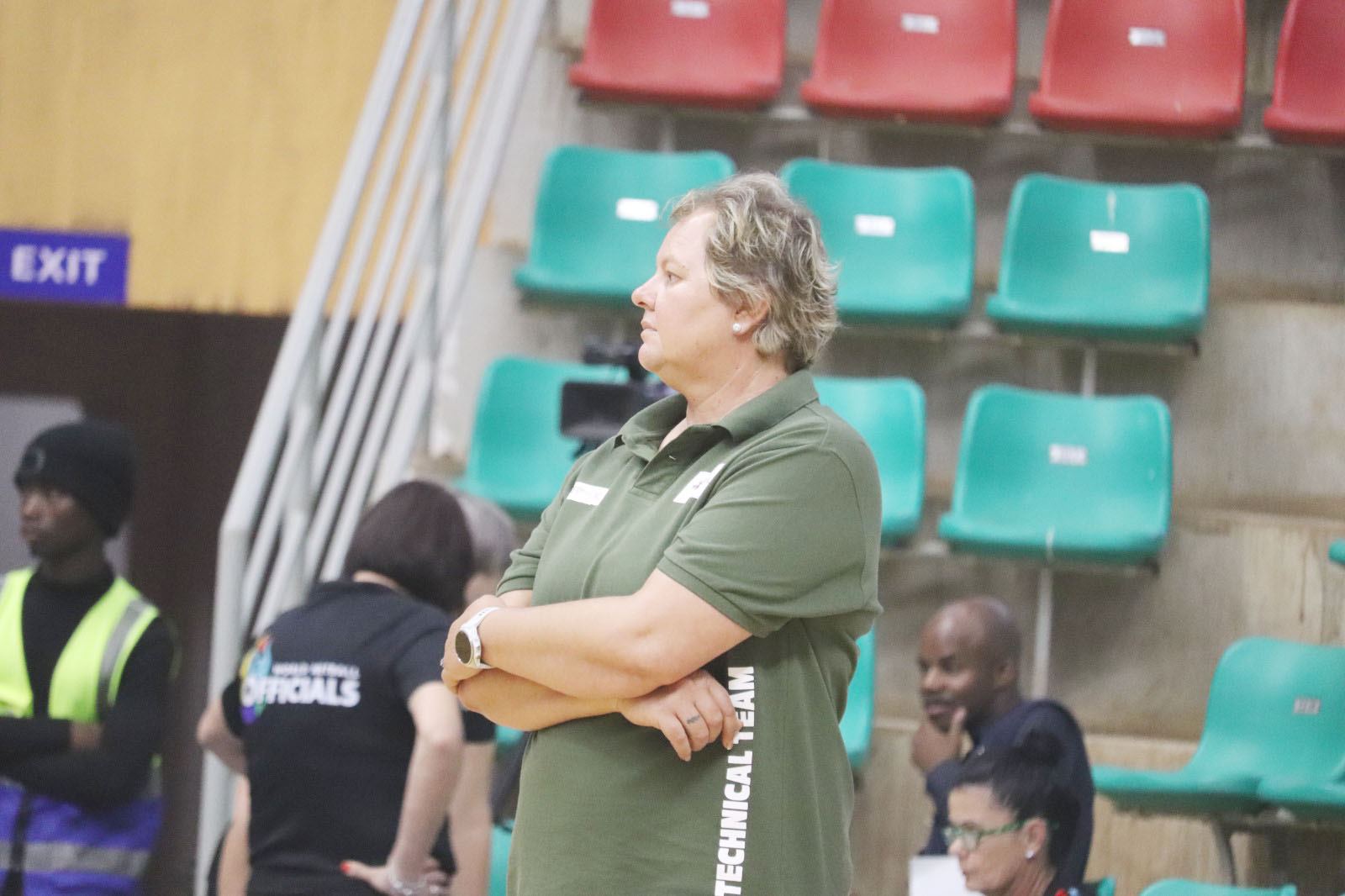

LILONGWE – Speaking after the DebMarine Desert Jewels secured a seventh-place finish at the Africa Netball Cup in Lilongwe, Malawi, head coach of the DebMarine Desert Jewels, Julene Meyer, said that national coaches need more training time with players and more frequently, and that local clubs need to buy into the concept of more structured netball, skill development, and high-performance criteria.
Namibia’s campaign at the continental showpiece was one of contrasts, blending difficult realities with encouraging signs for the future. The Jewels travelled to Malawi with a relatively inexperienced squad, further complicated by the unavailability of several senior players, who could not be released due to work commitments. The absence of key figures, including goal shooter Anna Kasper and Louise Dreamy Kausehue, disrupted combinations, with the likes of Monica Gomases and Loide Kanyolo joining the team only for the seventh and eighth-place playoff against Tanzania.
Despite these challenges, the cup served as a valuable platform for emerging players to test themselves against some of the continent’s best.
Looking ahead, the technical team has identified several areas requiring attention as the Jewels seek to close the gap with higher-ranked African nations.
“We need to become accountable with the ball in hand, value our possession, be consistent in our execution, we need to be composed under pressure, and be able to become clinical with ball in hand,” said Meyer.
She acknowledged that one of Namibia’s persistent hurdles has been breaking down teams such as Zimbabwe and Uganda, opponents who continue to hold the upper hand in key moments of matches.
“I believe it’s because we treat these teams for their ranking and not their skill, we treat them as if they are supposed to be better than us, because they are higher ranked, then we feel pressure because of our inexperience in the start and they capitalise on our nerves.
For a long time, we relied on Kaspar and Kausehue to start for us and absorb the pressure, and then the impact players came on from the bench, so depth plays a role, and changing impact players into starters, and the mental toughness aspect plays a huge role in this transition,” added Meyer.
Beyond match-day execution, broader questions remain around player production, development structures, and the role of domestic competitions in preparing players for the demands of international netball. “I believe it’s a combination of these, as national coaches, we need more training time with our players and more frequently. Clubs need to buy into the concept of more structured netball, skill development, and high-performance criteria like the expense rates and conditioning of players. At a development level, we need pathways from younger ages to lead to exposure at an international level, high-quality coaching at younger levels. These are all factors that would create exposure and experience for players, which in turn will translate to depth and continuity for the Jewels,” explained Meyer. She also stressed that responsibility does not lie solely with the national setup, but with the entire netball ecosystem, from administrators to clubs and coaches at the grassroots level.
“We need to create these areas, and we need improvement in our local leagues. We need to be part of every quarter in our MTC Netball Premier League. Whether it’s with power plays or super shots, we need to create playoffs, build big-match temperament, and demonstrate composure under pressure in crossover and placement finals. We need the buy in of the players, coaches and clubs to want to become national assets ready for call ups and then being prepared for the physicality, intensity, efficiency and the ability to have tactical discipline and following game plans, but this is only possible if clubs have coaches who are competent to coach and teach discipline, structure, skill, give instructions on game plans and to believe in structured netball,” added the coach. Supporters eager to see the Desert Jewels back on the court will have to wait a few months, but the calendar ahead promises important milestones.
“The Desert Jewels will be in action in Dubai in June 2026, defending our United Arab Emirates Netball Cup title and then in September 2026 in Kenya at the Africa qualifiers for World Cup 2027, we are working on two other events which are yet to be confirmed, but hopefully fans will be able to enjoy the Jewels in action on home soil in 2026,” further said Meyer.
The Africa Netball Cup was eventually won by defending champions South Africa, who closed out the tournament in emphatic fashion on Sunday evening with a 56–34 victory over Uganda to retain the women’s title.
In the men’s category, South Africa also successfully defended their crown, overcoming Zimbabwe 40–29. -lmupetami@nepc.com.na