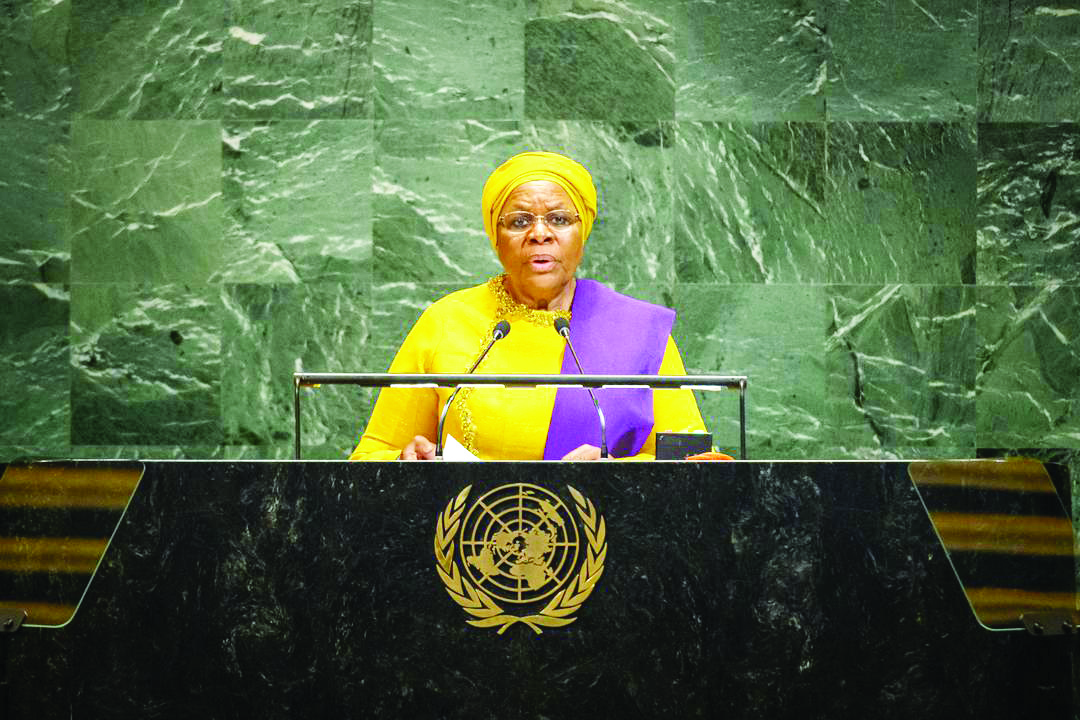

The moment President Netumbo Nandi-Ndaitwah walked into the grand hall of the United Nations General Assembly on Wednesday, the atmosphere shifted. Delegates ululated, clapped and cheered, breaking the usual formality as she strode to the podium to deliver her maiden address.
In a hall where protocol often prevails over passion, the lively welcome was matched by a speech that combined moral clarity, personal history and practical proposals.
The Namibian leader used the occasion to argue that even small nations can help shape a fairer global order.
“My personal journey with the United Nations began in 1974,” she said, recalling the organisation’s role in Namibia’s struggle against colonialism. That experience, she added, obliged her to speak for today’s oppressed peoples and to demand fairness in international governance.
When she turned to issues of global justice, President Nandi-Ndaitwah’s voice grew firmer, and the General Assembly hall grew quieter. She demanded an end to unilateral sanctions against Cuba, Zimbabwe and Venezuela, calling them measures that “go against the spirit of multilateralism.”
She described the sanctions as an unfair burden on ordinary people.
“We call for an end to the continued illegal economic, financial, and commercial embargo imposed on the friendly people of Cuba and for removing her from the list of states sponsoring terrorism,” she said. She added that the same principle of fairness demanded an end to sanctions on Zimbabwe and threats against Venezuela.
She said unilateral coercive measures, in her view, had no place in a world striving for equality. Nandi-Ndaitwah then pivoted to one of the most divisive debates in the Assembly — the war in Gaza. She cited the UN’s own Commission of Inquiry, which found evidence of genocide in the occupied Palestinian territories, and pressed the Security Council to act.
“A failure to address the crisis in Gaza could become the moral failure that defines this era,” she warned, urging consensus to end the long-standing conflict between Israel and Palestine.
What made her words resonate was how she tied global suffering to Namibia’s own past. “Namibia’s history is one of untold suffering marked by apartheid, colonialism and genocide,” she said. “It is our painful history that compels us to speak out, not out of bitterness, but conviction of the power of international solidarity.”
She described the “unprecedented human suffering” of Palestinians as a test of conscience for the entire world. “The people of Palestine must also benefit from the noble promises of the United Nations Charter,” she added, calling for constructive dialogue to replace violence. It was in this section that the Namibian leader’s voice carried the deepest weight — drawing from her country’s own scars to argue for fairness and dignity far beyond its borders.
The President also used her maiden UNGA address to press for one of the most persistent demands of African leaders — meaningful reform of the United Nations itself.
“The call for meaningful reform of the United Nations has never been more urgent. Stressing that reform must democratize global governance, amplify marginalised voices, and ensure international law serves as “a shield for the most vulnerable, not a tool of convenience,” she declared.
She reminded delegates that Namibia has already played a part in shaping the conversation. Last September, Namibia co-facilitated the UN Summit for the Future alongside Germany. That meeting produced the Pact for the Future and two annexes – the Global Digital Compact and the Declaration on Future Generations.
“The Pact challenged leaders and peoples of the world to renew commitments to multilateral cooperation, reminding us that our collective survival depends on unity,” she said. She reaffirmed Namibia’s commitment to international law and the multilateral order, calling it not just a legal duty but “a moral imperative.”
“We must reaffirm our commitment to the principles that unite us: mutual respect, the peaceful resolution of disputes, and solidarity in the face of common challenges,” she said.
As the hall once again filled with applause, she left the world body with a challenge to see this moment not as one of despair but of renewal.
“We have the opportunity to restore hope. To build a future defined not by division, but by unity and the preservation of human dignity,” she said.
Solutions
She announced Namibia’s bid to host the African Regional Hub of the Green Climate Fund, framing it as a way to help African countries access green finance and speed up adaptation.
She also highlighted her country’s Energy Compact, designed to secure concessional finance for renewable projects.
“We are committed to contributing solutions, not just demands,” she said.
On technology, she struck another note of foresight. Warning against the unregulated spread of artificial intelligence, she said AI must “not be a substitute for human judgment or responsibility” and called for global standards to ensure transparency and fairness.
She announced Namibia will host two high-level events on the Women, Peace and Security agenda, one in New York and another in Windhoek, signalling her determination to put women at the centre of peacebuilding.
Nandi-Ndaitwah also spoke of creating a National Youth Fund and reducing university fees to empower young Namibians. By linking her country’s domestic reforms to global principles, she showed that Namibia is not only asking for support but also leading by example.
Reforms
The President argued strongly for UN Security Council reform, backing the African Union’s Ezulwini Consensus and the Pact for the Future as frameworks to ensure Africa has a real voice in decision-making.