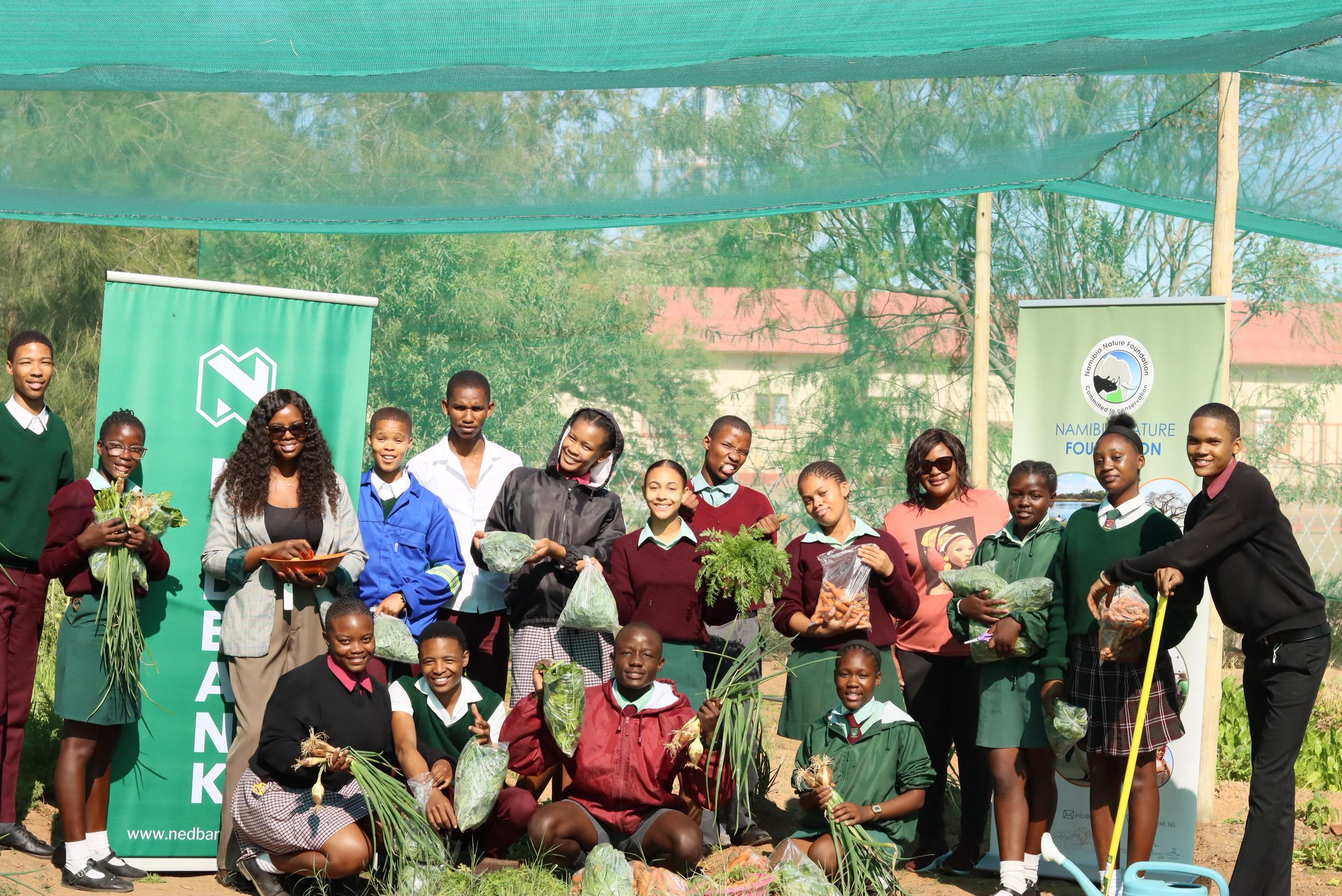

Under the harsh southern sun, where water is scarce and the soil often resists cultivation, a determined teacher decided that her school deserved more than dry ground and an empty stomach for the learners.
What began as a dream to feed vulnerable children has grown into a thriving green space, a place of learning, nourishment, and hope.
At Keetmanshoop Secondary School (KSS), agriculture and biology teacher, Penexupifo Shonena is leading a project that proves that even in Namibia’s arid southern regions, sustainable farming can take root with the right support and a lot of heart.
KSS is home to 615 learners, and for many, this has become both a classroom and a lifeline.
“When I first arrived at KSS, the garden was dry and lifeless, but seeing my learners come to class hungry motivated me to start something that could make a real difference,” she said.
The difference began when the school received a total of N$40 000 in funding from the Go Green Fund, a partnership between Nedbank Namibia and the Namibia Nature Foundation (NNF). The fund supports individuals and organisations working toward a more sustainable future while promoting environmental education to improve local livelihoods and awareness on climate change adaptation.
Since its inception, the Go Green Fund has invested around N$7 million, to support more than 30 projects across Namibia. The KSS initiative was supported under the fund’s ‘Green Urbanism’ request-for-proposal, which encourages innovative, sustainable solutions within community settings.
With Go Green Fund’s support, Shonena and her learners installed a drip irrigation system, built shade net structures, and began cultivating vegetables to support the school’s soup kitchen, which feeds vulnerable learners twice a week. “The drip irrigation system has helped us save water because every drop counts here,” said Shonena.
“And we’ve kept everything organic, using compost and manure instead of chemicals,” she added.
Despite facing challenges such as high setup costs and the relentless southern sun, the garden still flourished. Learners now take part in practical agricultural lessons right in the soil they’ve helped nurture, connecting classroom theory with real-life experience.
“Our Grade 11 agriculture practical results have improved so much. The students understand the process because they’ve experienced it from planting to harvesting,” she said.
Out of the school’s 615 learners, 16 learners are directly responsible for maintaining the garden. They nurture spinach, carrots, onions, peas, and cabbage that go straight into the school’s meals. At the heart of the kitchen is Hedwig Lambert, affectionately known as Auntie, a volunteer who cooks for the learners and makes sure that no child goes home hungry.
Beyond the school fence, the ripple effects are spreading. Parents and community members have begun visiting the garden for advice on how to start small home or backyard gardens.
Support from local institutions has also been highly encouraging. When the school reaches out for assistance, responses are often swift and enthusiastic. The Namibia Correctional Services promptly offered manpower to help clear weeds, while the Ministry of Agriculture, Fisheries, Water and Land Reform continues to provide valuable guidance and technical support whenever needed.
“It’s no longer just a project submitted for funding. This is a life-long initiative that the school, the community, and everyone can be proud of. The Go Green Fund truly transformed our garden by giving us more than equipment; it gave us hope,” says Shonena.
Nedbank Namibia Head of Marketing and Communications, Gernot de Klerk echoed the sentiments of Shonena by highlighting the bank’s mandate of the Go Green Fund.
“At Nedbank Namibia, we believe that sustainability begins at the grassroots level. Our support for the Keetmanshoop Secondary School vegetable garden is a powerful reflection of the Go Green Fund’s mission—to empower communities through environmental stewardship and sustainable resource use. This initiative not only promotes food security and environmental education among young Namibians but also nurtures a culture of self-reliance and ecological responsibility. It’s a small garden with a big impact, and we are proud to be part of its growth,” he said.
As the garden continues to grow, the school dreams of expanding, ultimately working to add a cooling facility, a nursery, solar panels for the soup kitchen, a water tank, and further training for learners in sustainable farming. Until such time, every harvest is a celebration of resilience, learning, and the power of starting small.