
This year, the government demonstrated its commitment towards the arts, culture and heritage industry by launching the Namibia Arts, Culture and Heritage (NACH) Policy and a financial boost of N$50 million for the 2025/26 financial year.
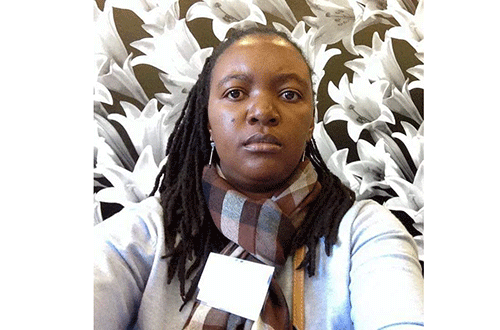
New Era Journalist Priscilla Mukokobi (PM) engaged Gretta Gaspar (GG), Office Administrator at the National Arts Council of Namibia (NACN), to discuss the state of Namibia’s creative industry, the council’s role in helping creatives, funding processes, and how it supports mobility, training and skills development.
PM: What is the core mission of the National Arts Council?
GG: The NACN’s core mission is to promote, develop, and support the creative sector. Our mandate is to ensure that arts and culture thrive in Namibia by providing the tools and resources creatives need to succeed.
PM: How exactly does the Arts Council help the creative industry?
GG: We regularly issue grant calls every three months, along with an annual bursary programme, which closed on 21 November. We also support mobility grants for artists travelling abroad and maintain long-term partnerships and sponsorships to strengthen the sector.
PM: How do you decide which artists or projects receive funding?
GG: It is a competitive process. We begin with a public call, after which sector experts independently evaluate the applications. Their recommendations are then presented to the council, which makes the final decision.
PM: What are the basic requirements to qualify for funding?
GG: Applicants must be Namibian citizens aged 18 or older and must not be full-time students, as students should apply for bursaries instead. The project must be creative, and applicants must follow the guidelines, demonstrate strong conceptualisation, and show how they plan to sustain it.
PM: Do beneficiaries receive mentorship support?
GG: Not yet. We currently face capacity constraints due to having only five staff members. However, expanding our organogram to include mentorship, monitoring and evaluation roles is part of our long-term vision.
PM: How much does the council spend annually on grants and bursaries?
GG: The council receives a grant-in-aid of N$5 million from the government, which is distributed across all our funding programmes. Although this amount is limited, we supplement it by actively seeking donor support to sustain the sector.
PM: How many creatives have benefited from the Mobility Fund this year?
GG: Ten, however, that number can be misleading because a single application sometimes represents a group of up to 60 people. Mobility grants are flexible, allowing artists to apply whenever opportunities arise.
PM: How many applications do you receive annually?
GG: Mobility grants are still new, so the numbers are small but steadily increasing. We see more interest every month.
PM: What criteria must creatives meet to benefit from any of the NACN funds?
GG: All guidelines, criteria and application forms are available on our website. Applicants download the form, tick the required documents, submit, and the council then evaluates the application before issuing a response.
PM: Who are the council’s current donors?
GG: We work closely with Unesco, which funded the review of the National Arts Council Act and supported the development of new regulations. Their contribution has been instrumental as we await further action from the ministry of justice and Parliament.
PM: Are there any new projects the council is currently running?
GG: At the moment, no. We are operating under an interim board while awaiting the appointment of a new council. Once the new team is in place, a fresh strategic plan will be developed.
PM: Which creative genres are prioritised for funding?
GG: We treat all genres fairly, including fashion, performing arts, heritage, visual arts and live arts. Our partnerships reflect this diversity. Recent priorities have included Heritage Week, Mad Geyser, Katutura Fashion Week, the City of Windhoek Jazz Festival, where we funded all Namibian performers and the Otjomuise Live Arts Festival in collaboration with the National Theatre of Namibia. We ensure that Namibian creatives come first.
PM: When you say you “took care” of artists at the Jazz Festival, what do you mean?
GG: We paid all Namibian performers who participated. Our mandate is to ensure that artists are supported and fairly compensated at national events.
PM: What is the future of Namibia’s creative industry?
GG: From this conversation, one thing is clear: Namibia’s creative future is promising but requires sustained support. With more substantial funding, better structures, new partnerships, and more platforms for dialogue, the creative economy has the potential to become one of the country’s most powerful cultural and economic engines. The National Arts Council plays a pivotal role, but collaboration among artists, government, donors and the public remains essential.
PM: Do you have a final message for Namibia’s creatives?
GG: I would love to see more platforms like this, spaces where creatives can speak, engage and share ideas. Dialogue is crucial, and we hope to see more voices amplified within our creative ecosystem.
-pmukokobi@nepc.com.na