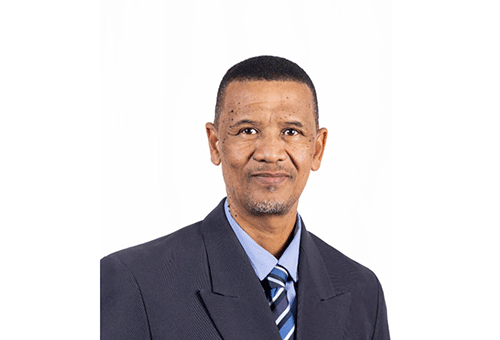

After being in office for just over three months, newly appointed //Kharas regional governor, Dawid Gertze (DG), is adamant to develop the region to greater heights, but only if all relevant public and private stakeholders are willing to come on board to realize this vision with him.
New Era’s Keetmanshoop based journalist, Steven Klukowski (SK) sat down with the region’s first citisen to probe him on this and other controversial issues pertaining to his mandate.
SK: The first time you addressed citizens during the handing over of power from the former governor, Aletta Frederick, you said, “I hate people only making noise and doing nothing practical or noticeable.” How does this statement resonate with the way you will run and manage the //Kharas region with all private and public stakeholders’ support?
DG: What I meant was that talking only cannot solve issues, I am one going for substance dialogue. Citizens should not only complain, but also provide possible solutions as they have better knowledge on the ground on what their challenges are.
SK: Another message you sent out was, “If stakeholders do not come to my office, I will visit them.” Did this motto work well in the performance of your duties so far?
DG: This is indeed the platform from where I will execute my plans. I cannot wait for residents to delay or shy away from visiting my office. As a means to familiarise myself with the situation on the grassroots level, I already started visiting traditional authorities and recently engaged the community of Aus.
SK: The ruling political party (Landless Peoples Movement/LPM) in the region’s councilors at times did not attend the State of the Region Addresses (SORA) of the previous governor, whilst this year it was now regarded as a special council meeting, making it obligatory for all regional councilors to attend. During 2025, they fully supported your Sora. What, in your view, was the reasoning behind it in the past? How best will you describe the working relationship between your office and that of the councilors to date?
DG: I cannot divulge much as to what happened in the past, but has on one occasion reached out to the LPM leadership to cement a proper political platform in the region. It is rather important that we, as the political leadership, regardless of political affiliation, should work hand-in-hand to serve our community. There are also no bad vibes between us in the sense that the //Kharas regional council chairperson, at times, stands in for me if I cannot attend events.
SK: You also said President Netumbo Nandi-Ndaitwah instructed you, as a Goab to go and unite residents in the region. What was your journey till now in this regard?
DG: My approach till now is that I go out and listen to people, be it citizens, politicians, traditional authorities or members of the business fraternity; to connect them all towards one synergy that is to approach and address challenges we experience together and leave racial, political, and other personal differences behind for now as the government is not there for a specific group, but for all citizens in the region and the country at large. I am also actively working with traditional authorities to solve obstacles like leadership succession and division so that we can stand together as one nation.
SK: What robust interventions will your office, with the necessary support, implement to make //Kharas shine again on the Namibian map?
DG: //Kharas as a region is endowed with multiple resources, but having the highest poverty levels. It cannot be business as usual anymore; we must vigorously start to take ownership of these resources and get economically empowered in the process. Another approach will be to exploit the numerous untapped opportunities we have in place. Once again, it is all about unity in purpose.
SK: Oil, earth gas , and green hydrogen discoveries have been made in the region or will be manufactured in the near future. Heeding the government’s call for inclusivity and also calls made to let citizens of the two southern regions be prioritised when it comes to reaping future benefits, how will the political leadership implement this accordingly?
DG: Learners from the two southern regions are already enjoying preferential priority for opportunities to pursue studies in these energy fields, which is a direct result of political leaders engaging on the agenda. In addition, most procurement processes will now benefit our local entrepreneurs, whilst employment opportunities will also be prioritised for unemployed residents in //Kharas and Hardap regions. So, in a nutshell, the ball is rolling.
SK: One of your priorities as governor is to open a youth desk at your office. Can you please elaborate more on how this function will benefit the youth in the region?
DG: I can with confidence state that the process has started in that the ministry of youth has seconded one of their officers to my office, who will now assist in facilitating the full operationality of the youth desk.
SK: Another challenge you want to address is the allocation of resettlement farms, as many remain unoccupied. As chairperson of the regional resettlement committee/ communal land board, what progress has been made thus far?
DG: Unoccupied resettlement farms is really an issue of big concern to me. The fear is that the government might take back this land if something drastic is not done about it. The bureaucracy and red-tape approach from the national level during the allocation of these farms to our potential beneficiaries, however, also contributed to this state of affairs in one way or another. My office is, however, working on modalities on how to address the situation soonest.
SK: In one of your speeches, you suggested that white commercial farmers should come on board and join hands with communal and resettled farmers in training them on best practices of successful farming production. Was this idea kick-started yet?
DG: The Swapo party political manifesto and NDP6 clearly speak a lot about the importance of farming and agriculture as a leading contributor towards the country’s economic emancipation and Gross Domestic Product. More now than ever, white commercial farmers should come on board with their excellent knowledge and experience on how to make the sector productive and share it with our less privileged communal and resettlement farmers, uplifting them in the process. I am in the process of engaging chairpersons of white farmers’ associations in the region to come and join hands with us.
-sklukowski@nepc.com.na