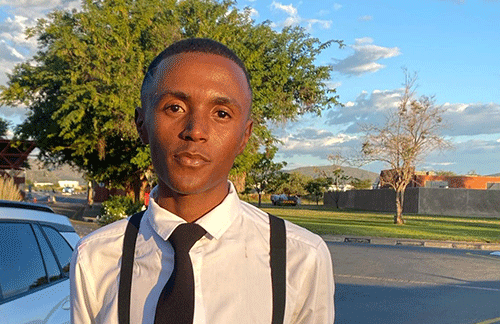

Everet Herman Pieters
Urban inequality in Namibia is not merely the result of technical oversight or policy failures; it is a manifestation of structural violence that continues to marginalise grassroots urban governance.
It reflects an ideological blind spot: a refusal by formal institutions to acknowledge the political agency embedded in the everyday practices of the urban poor. In Windhoek’s under-serviced areas — Oshitenda, Havana, or Kabila — residents are not waiting to be included.
They are already governing; they have named danger zones. They have formed committees, regulated land, and warned their children where not to walk. In other words, they are the city’s infrastructure.
Yet, public discourse continues to reduce these communities to “informal settlements”.
This language is not neutral. It erases the intelligence, structure, and politics that already exist. It renders the labour of the poor as invisible, as temporary, as incomplete. It tells a story of waiting — waiting for land, for lighting, for legitimacy — even though these communities are already shaping the city’s survival.
Take “Devil Straat”, a road so named by residents because of its danger, its lack of lighting, and its record of violence. Or Donkerhoek, literally “dark corner”, a stretch of Katutura that remains unpatrolled and unacknowledged in public safety plans.
These names are not folklore; they are vernacular urban planning. They are data.
And yet, this knowledge rarely makes it into policy documents or safety interventions.
This disconnect between what the people know and what the City acts on is not accidental. It is structural. It reveals how urban planning regimes continue to treat the poor as data points, not designers.
What communities know is dismissed because of who they are. That is what philosopher Miranda Fricker calls “epistemic injustice”: when some people’s knowledge is deemed less valuable or less true than others.
But Windhoek’s “informal” settlements are far from disorganised. Oshitenda has had a land committee in place for over a decade. Kabila residents share meters, navigate unpaved streets, and regulate land boundaries through community agreements.
These systems function with or without the City’s support. And yet, they remain unrecognised because they do not speak the language of formality.
Anthropologist AbdouMaliq Simone has written about how “people are infrastructure”, arguing that in contexts of failed development, it is human cooperation that sustains the city.
In Windhoek, this idea is not theoretical; it is lived. But this reliance on the resilience of the poor cannot continue indefinitely. To keep calling them “informal” is not just inaccurate; it is violent.
Language becomes a gatekeeper to inclusion. These areas are “left out” not because they lack structure, but because their structure is not recognised.
Cities are not built with bricks alone. They are built with meaning. And when meaning is stripped from the communities that create it, inequality becomes more than an outcome; it becomes an operating principle.
If city planning continues to ignore the vernacular (residents’ own terms, categories, and systems), then no policy will ever feel just.
The idea that the city must first be developed before it is shared must be overturned. People are not waiting for justice. They are living it, resisting its absence, and designing their survival.
Urban inequality, then, is not just a policy problem. It is a knowledge problem. And until we reject the colonial inheritance of urban planning and build a planning ethic rooted in democratic recognition, spatial justice, and the co-production of urban futures, inequity will persist. Urban justice will only be achieved when those who endure inequality are empowered to define what justice looks like, where it is needed, and how it should be delivered.