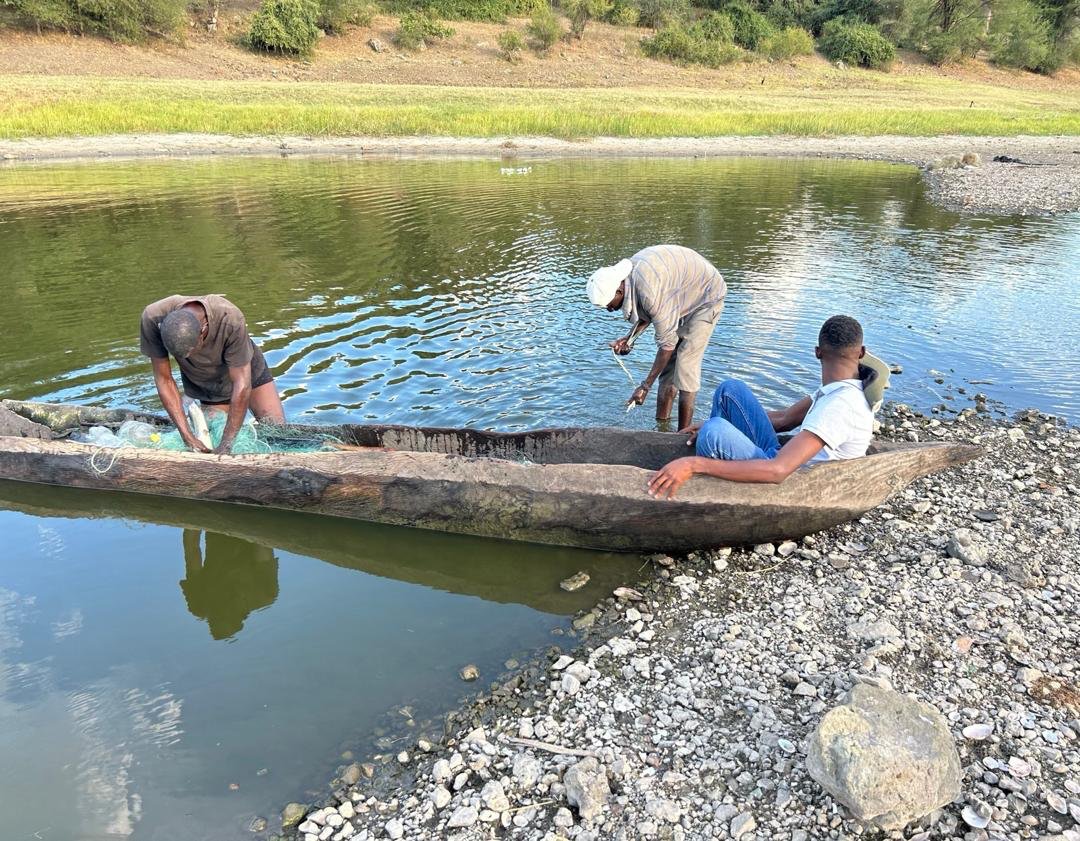

LAKE LYIAMBEZI – As farmers in the Zambezi region increasingly plough large tracts of land – some as extensive as 50 hectares – around Lake Liambezi to boost crop production, concerns are growing over the sustainability of agricultural expansion.
Historically, local communities have relied on Lake Liambezi during wet cycles for fishing, grazing and subsistence activities, making the lake both an ecological and socio-economic asset.
Liambezi is renowned for its rich biodiversity, supported by diverse flora and fauna, and forms part of a wider transboundary ecosystem.
The area also serves as a critical wildlife corridor, with animals regularly roaming in from Botswana via the Chobe River.
Buffaloes, zebras, ostriches and elephants are commonly seen, underscoring the lake’s ecological significance.
However, large-scale cultivation near the long stretching lake has raised alarms about habitat degradation, rising human–wildlife conflict and the long-term balance between livelihoods and conservation.
To address this, conservationist Morgan Sai Sai has proposed a shift for the Lake Liambezi area, advocating for ecotourism in place of extensive agriculture and livestock farming. Citing the presence of elephants, buffaloes, leopards and lions, Sai Sai argues that the region is failing to fully capitalise on its natural assets.
Importantly, Lake Liambezi is an intermittent (seasonal) lake, as it does not hold water permanently and can dry up for long periods during low rainfall years.
During high rainfall and major flood events – particularly when the Zambezi and Chobe systems overflow – the lake refills, sometimes dramatically, expanding over a wide area.
“Currently, for me, cropping and livestock production units in the lake are a waste of use,” he said, adding that tourism offers a more sustainable and profitable alternative.
Sai Sai, who is also the Ministry of Environment and Tourism’s chief control warden for the Zambezi, envisions a transformed landscape that includes game drives, walking trails, viewing decks and cultural museums, drawing inspiration from successful ecotourism models he observed in China.
“Tourism is activity-based,” he said. “Once we realise the value of our natural resources, we can create exciting and profitable ventures that also preserve our environment.”
Lake Liambezi was formed as a result of periodic flooding and changes in river flow patterns within the Zambezi floodplain.
The lake lies in a low-lying basin that historically received overflow waters from the Kwando River, which feeds into the Linyanti–Chobe River system and ultimately connects to the Zambezi River.
His proposal also emphasises integrating local culture and historical sites into a broader tourism circuit, which he believes could deliver lasting economic benefits to communities in the Zambezi region.
Sai Sai criticised what he described as a lack of vision and leadership, arguing that untapped potential continues to be overlooked.
“We have a challenge in Africa – lack of vision and leadership,” he said. “Where there is potential, you don’t see that potential being maximised.”
Over centuries, natural processes such as shifting river channels, sediment deposition, and tectonic movements within the Zambezi Basin created depressions that allowed floodwaters to accumulate, giving rise to Lake Liambezi.
When filled, the lake becomes a biodiversity hotspot, supporting rich aquatic life and productive fisheries.
It also sustains floodplain grasses and vegetation, as well as large populations of wildlife, including elephants, buffaloes, zebras and numerous bird species.
– anakale@nepc.com.na