

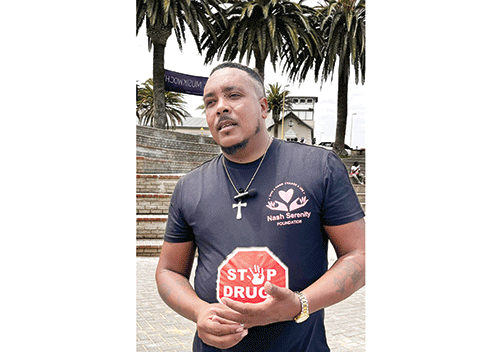

SWAKOPMUND – Swakopmund resident Patrick Nashandi is on a mission to pull others out of the darkness he once knew too well.
At 39, he runs a soup kitchen, mentors street children and offers free haircuts to restore dignity — a life far removed from the trauma, addiction and homelessness that once defined him as a person.
Now clean for the past five years, the married father speaks about his struggle, which resulted in his life spiraling out of control to the point where he ended up in jail — a turning point that pushed him to help others become clean and live purposeful lives.
Nashandi openly speaks about the experiences that shaped him into a man on a mission to help others escape drug addiction. During a drug awareness walk he organised over the weekend, he opened about his trauma at the age of ten, when he was sexually abused by a teacher — a trauma he never dealt with, which later shaped the course of his life.
By 15, he was already drinking and smoking and later turned to selling drugs. He later landed in prison, where a stranger handed him a Bible — something he describes as the beginning of his transformation.
Behind bars, Nashandi says the noise of the outside world finally faded. It was the first time he could hear himself think and start asking the right questions. After serving almost a year, he walked out determined to change his life and become a support system for others trapped in addiction.
Birth of the Nash Foundation
Nashandi does not hide his past. “I’ve been an addict for more than 15 years. I suffered trauma at the age of 10. I grew up on the streets. I’ve done it all.
I’ve been in and out of prison, and I’ve been homeless at times,” he says.
This is what led to the creation of the Nash Foundation.
For him, the organisation is rooted in compassion — being a voice for those who feel unseen and misunderstood, and helping others trapped in drug addiction.
“People who don’t use drugs don’t really understand what goes on inside the heart and the mind, he said.” According to him, people do not use drugs for the sake of it — the drugs numb pain and unresolved trauma.
Nutrition and recovery support
He says he made a firm decision when he walked out of prison to live a life free of drug abuse.
According to him, drug addicts completely forget who they are and chase the next fix, often spending their last dollars on drugs rather than food. Therefore, the foundation focuses on nutrition so that addicts can make better decisions about their future.
“I understand hunger too well. I used to go without food for days — something many addicts still experience as drugs become their only priority,” he said. He says all addicts speak one language: getting drugs. Eating becomes secondary. Hence, he focuses on giving addicts a decent meal, which he believes lays the foundation for kicking addiction.
Besides meals, the foundation offers addiction support, recovery coaching and guidance to families who often do not know where to begin. Nashandi also plans to start a programme in January to help young people obtain learner’s and driving licences.
According to him, support must continue even after recovery so people can become productive citizens. “Sending someone for rehabilitation without a proper structure to reintegrate into society is another challenge that hampers recovery,” he says.
Spiritual support
According to Nashandi, spiritual support is one of the missing links. He says churches have not been forthcoming in assisting people who leave rehabilitation centres.
As a result, many people relapse due to a lack of support systems outside.
“I hope churches become more involved in the process, as support groups are needed to help people grow both mentally and spiritually once they leave rehabilitation centres,” he said.
Pastor Fredricks from Hosiana Parish admits that churches are not doing enough for recovering addicts. He says churches often focus more on funerals, weddings and confirmations, while those battling addiction lack the spiritual and emotional support they need.
“There is definitely a need for that,” he says. “We must assess our purpose and the impact we have. The spiritual support we render can change our society significantly.” He recently started a support group at his church for recovering addicts and abused spouses.
Patrick’s wife, Hermien Nashandi, also stresses the importance of strong family support. She says most recovering addicts struggle with feelings of worthlessness due to years of rejection. “They reduce themselves to nothing. That can cause relapse,” she says. “We must acknowledge every milestone they reach, she added.”
She admits that it has not been easy. Supporting someone through recovery comes with fears of relapse, and she believes families also need safe spaces. “Sometimes we cannot express our fears to them, but speaking to someone who understands helps a lot,” she says.
A message of hope
Nashandi says his message to anyone battling addiction is simple. He believes the fight against drugs requires unity and community involvement. “You matter. Change is possible. Look at me — if God can do this for me, He can do it for you. Don’t give up. We cannot do it alone. If we stand together, it becomes impactful,” he says. – edeklerk@nepc.com.na