
Lahja Nashuuta
Namibia’s small-scale mining (SSM) sector generates an estimated US$4 million annually, with a 2% royalty rate applied to semi-precious stone exports, according to the Ministry of Industries,Mines, and Energy.
The ministry says these royalties directly contribute to national revenue, while small-scale mining continues to play a critical role in grassroots poverty reduction and rural livelihood support.
SSM activities are regulated under the Minerals (Prospecting and Mining) Act of 1992, the Minerals Policy of 2003, and the Environmental Management Act of 2007.
Information from the ministry shows that there are two licences that apply to SSM operators: the Non-Exclusive Prospecting Licence (NEPL) and Mining Claims (MCs), which allow up to 10 claims of 18 hectares each per person.
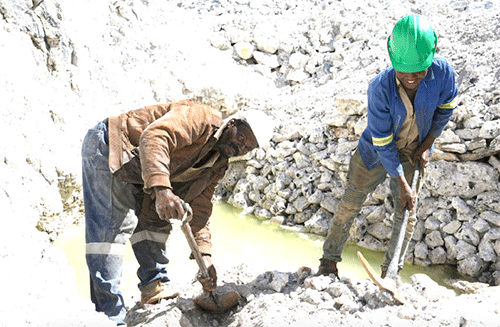
There are close to 10,000 small-scale miners active across the country, with the majority based in the Erongo, Kunene, and // Karas regions. These miners predominantly extract semi-precious stones, industrial minerals, and dimension stone materials typically overlooked by larger mining companies.
“Small-scale mining represents a vital component of Namibia’s mining industry. It is largely made up of operators who require low capital investment and minimal technical expertise,” said Ten Hasheela, the ministry’s Chief Public Relations Officer.
Hasheela indicated that around 35 different types of minerals and gemstones are mined by small-scale operators, with amethyst, tourmaline, garnet, rose quartz, and tiger’s eye being the most common. Some operators are also involved in the limited extraction of base and rare matals metals such as tantalite and tin.
Approximately 80% of small-scale mining activity involves gemstone extraction, while the remaining 20% targets industrial minerals and based and rare metals on a small scale.
“Operations are often informal, with miners working independently or in arrangements where investors provide equipment and supplies in exchange for a portion of the earnings. However, some have formed cooperatives and associations to improve access to government support, training, and technical services,” she said.
Hasheela pointed to the Uiba Oas Crystal Market in Erongo as one of the major sales hubs for small-scale miners, while noting that the majority sell directly to tourists in mining areas.
Challenges
Despite its potential, the sector is hindered by numerous challenges. Hasheela revealed that many miners lack the necessary equipment, and although the ministry offers an Equipment Aid Scheme, access remains limited.
She further identified financing as a major hurdle, as most miners struggle to access credit due to the informal nature of their businesses and the perception of high risk.
In addition, Hasheela noted that much of the mining takes place on private farmland, where access is negotiated through contracts that often favour landowners. The the Mineral Ancillary Rights Commission (MARC) assists with cases of land access upon application by SSM.
“Environmental compliance is another issue. Complying with the Environmental Management Act particularly the preparation of Environmental Impact Assessments (EIAs) and Environmental Management Plans (EMPs) can be prohibitively expensive. However, the ministry, with support from the United Nations Development Programme (UNDP), helps miners meet these requirements,” she explained.
She added that there is also a lack of decentralised services. Although regional offices for Erongo, Kunene, and //Karas have been approved, they are yet to be funded, leaving miners in remote areas without essential support.
Internal and regulatory constraints
Hasheela told New Era that many miners fail to comply with reporting obligations, and disregard environmental regulations. Meanwhile, inadequate budget allocations restrict the ministry’s ability to assist with equipment, training.
She cited outdated legislation as a barrier. “Certain provisions in the Minerals Act especially Section 16 need to be revised to enable greater small-scale miner participation and equitable access to mineral resources,” she said.
Despite the hurdles, Hasheela maintained that small-scale mining continues to support thousands of households in Namibia’s rural areas. Income from SSM helps families afford school fees, medical care, and basic necessities.
“Production remains difficult to quantify due to low levels of compliance, but previous estimates place the sector’s annual value at US$4 million,” Hasheela said, referencing to a study conducted by the BGR-GSN Project in the then Ministry of Mines and Energy
To further support the small miners, Hasheela said the ministry’s SSM Division has been assisting with mineral rights applications, claim registration, geochemical analysis, and environmental compliance.
“Through partnerships such as our collaboration with the UNDP, we are helping miners meet environmental requirements by supporting the development of Environmental Impact Assessments and Management Plans,” Hasheela said.
She also revealed that efforts are underway to add value locally.
“The ministry is working on establishing a gemstone cutting and polishing centre in Khorixas and a slate processing facility in Noordoewer to increase earnings and local beneficiation,” she reveals.
She adds “We encourage miners to form cooperatives and associations. These structures not only improve access to services and training but also open doors to broader markets,” Hasheela said.
She asserts that with adequate investment, legislative reforms, and decentralised support structures, small-scale mining can become a vital engine for rural development and a sustainable solution to Namibia’s persistent unemployment challenges.
-lnashuuta@nepc.com.na