

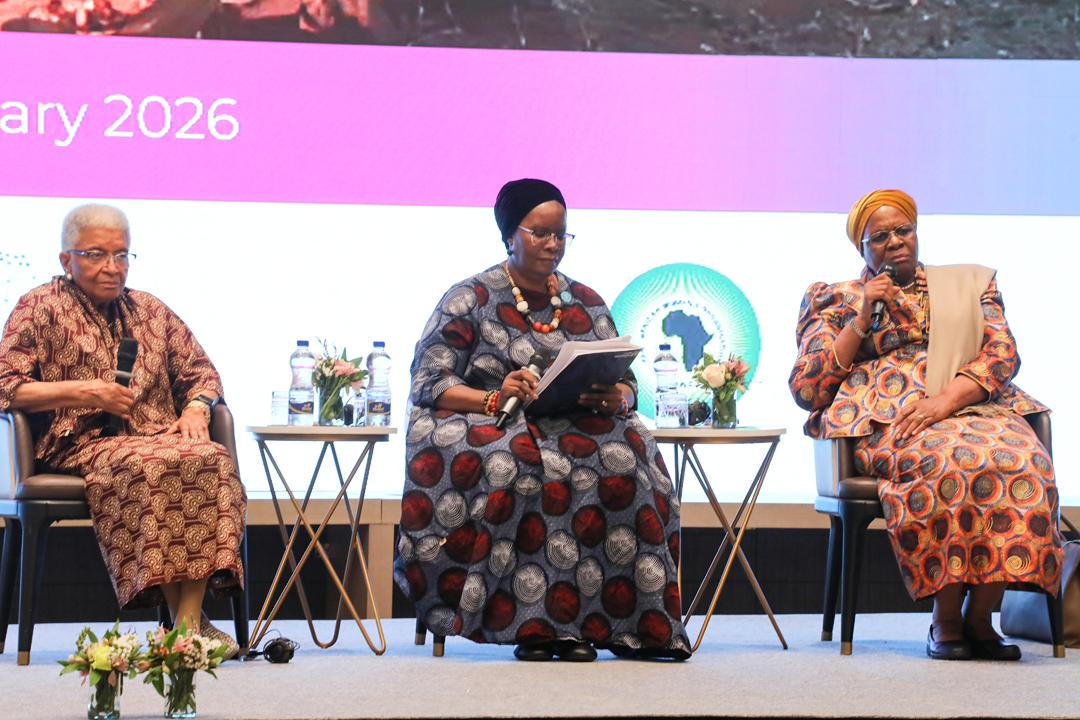

President Netumbo Nandi-Ndaitwah has called for women leaders in Africa to move beyond symbolism and deliver real peace, security and legal protection for the most vulnerable across the continent.
Speaking at a high-level Presidential Fireside Conversation on the margins of the African Union Summit on Friday, Nandi-Ndaitwah said Africa’s governance systems must fully integrate women into decision-making on peace, security and development if lasting stability is to be achieved.
The dialogue, co-convened by Namibia through its mission in Addis Ababa under the theme ‘Beyond Barriers: Women Leaders Reshaping African Governance’, brought together current and former female heads of state, continental institutions and global partners. Nandi-Ndaitwah shared the platform with former Liberian president Ellen Johnson Sirleaf, whose reflections on women’s peace and security reinforced the urgency of the Namibian President’s message. Nandi-Ndaitwah said Africa has made historic progress in elevating women to leadership positions but warned that representation alone is not enough.
Women, she stressed, must be placed at the centre of peacebuilding, security reform and governance if the continent is to address conflict, inequality and underdevelopment.
The President said inclusive leadership strengthens institutions and leads to more sustainable solutions, particularly in societies emerging from conflict or facing social and economic pressure. Responding to the discussion on peace and security, Sirleaf said the women’s agenda has gained resilience through continental frameworks but still faces deep structural challenges.
“We still have a long way to go to say that everyday peace and security becomes a part of the goals of every organisation and institution of every culture in the world,” Sirleaf said.
She highlighted the African Women Leaders Network, established through the African Union Special Envoy on Women, Peace and Security, which now operates in 37 countries. However, Sirleaf said legal and policy reforms remain critical.
“We need to look at where constitutional laws require reform. We need to go in policies,” she said. She also drew attention to women in the informal sector, who often face exploitation and violence.
“Perhaps we also need to look at those struggling women in the informal sector. Who gets victimised? The one who suffers most,” she said.